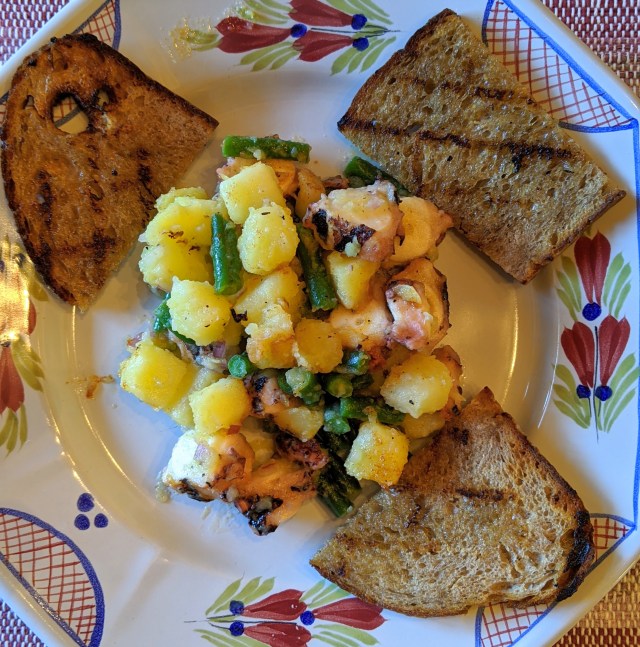
Lunchtime Surprises

These days I love lunchtime.  It’s an ideal time to resurrect leftovers or create new dishes with many of my favorite foods.  I am also finding that if I have one glass of wine at lunch   and a second glass at dinner, I don’t need a nap after lunch, nor do I snooze at the table after dinner.  Today was another of those good days.

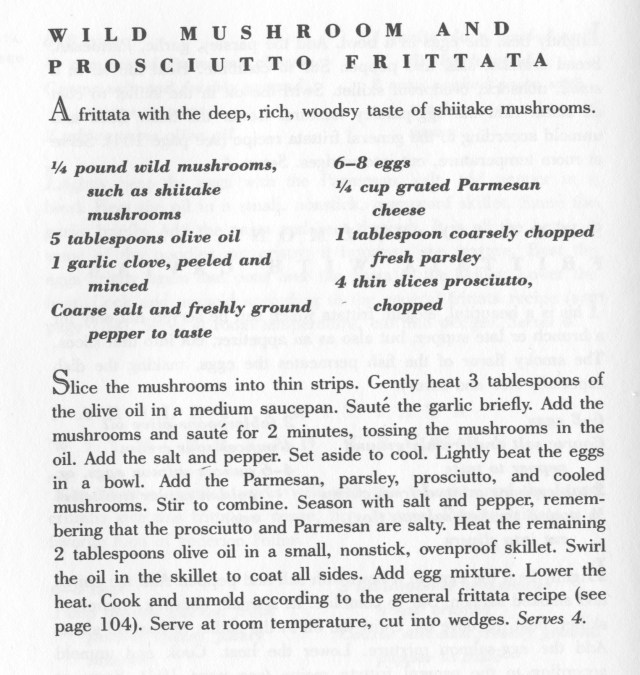
We have some Prosciutto I got delivered from Formaggio Kitchen in Cambridge recently.  It is sliced a little too thick for my taste as an antipasto, but it works well when cut into thin slivers in cooking (as I did last night in a side dish of sautéed spinach with garlic).  A quick search in my Italian cookbooks produced this recipe for a Wild Mushroom Frittata with Prosciutto, so that was my choice for lunch dish (using just 5 eggs).
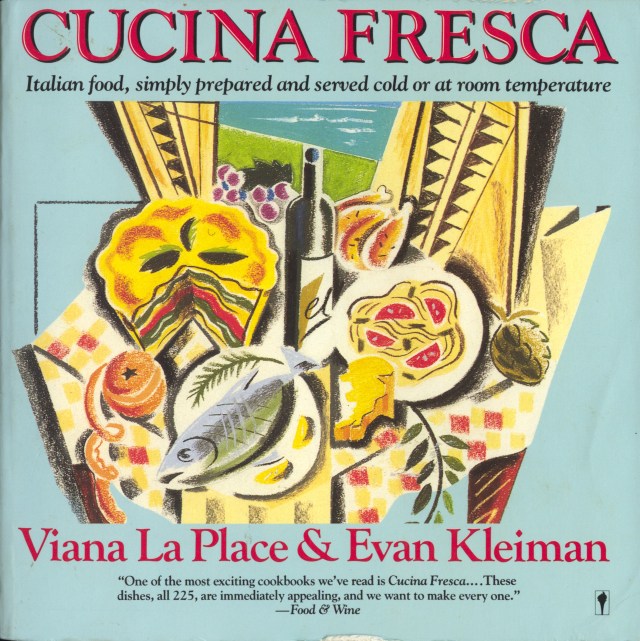
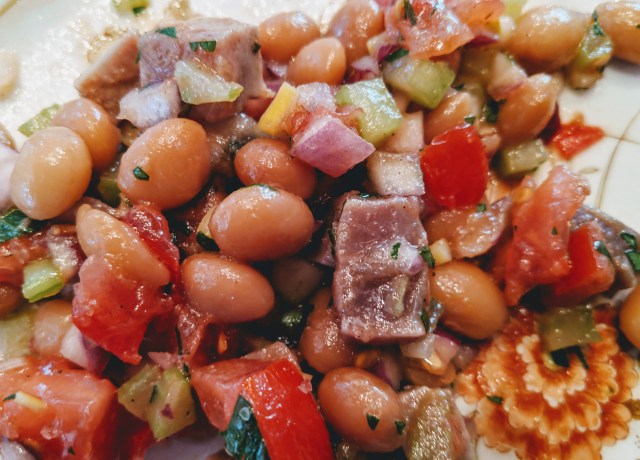
At the same time, I had been thinking about making a traditional Mediterranean tuna salad with the Tuna Conserva made a few days earlier.  To that end, I had taken some older dried white beans (Controne) and cooked them yesterday.  That was a task in itself.  Normally, dried beans which have been soaked overnight will get cooked the next day in 60-90 minutes.  These were old enough to need more than 3 hours, but they were safely in the refrigerator, ready to use this morning.  I had a small piece of Tuna Conserva (about 1/3 lb.), so it was easy to assemble the salad, once I chose the ingredients and cut everything into 1/2″ dice.
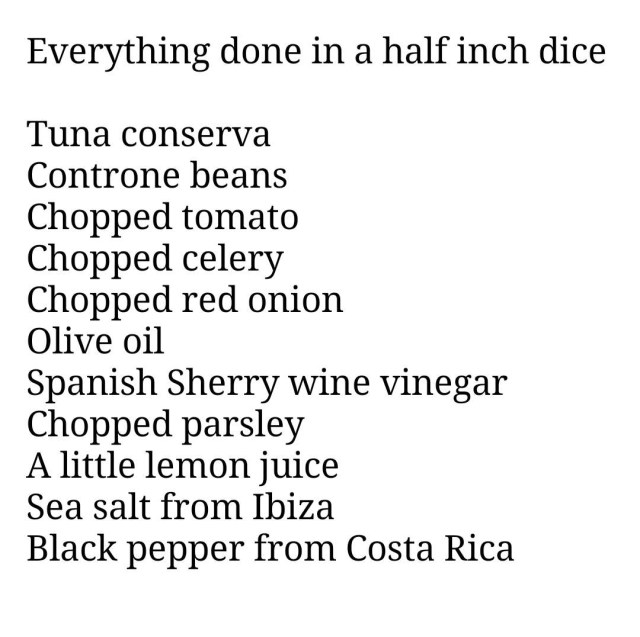
Surprise #1:  The Tuna Salad was superb, the highlight of the meal, and I needed a second helping to fully appreciate it.

Surprise #2: The wine I selected, a 1990 Dorigo Refosco from Friuli, was astonishingly good.   It was rich, full-bodied, and full of fruit.  Somehow I had the expectation that it would be past its prime and not particularly interesting.  Once again, the only way to know about a wine is to drink it.  Here is a 30-year old wine from Friuli worthy of note, and a very fine accompaniment to both dishes on my lunch plate.


Posted in Food, Wine | Leave a comment

Walks, and Another Italian Lunch

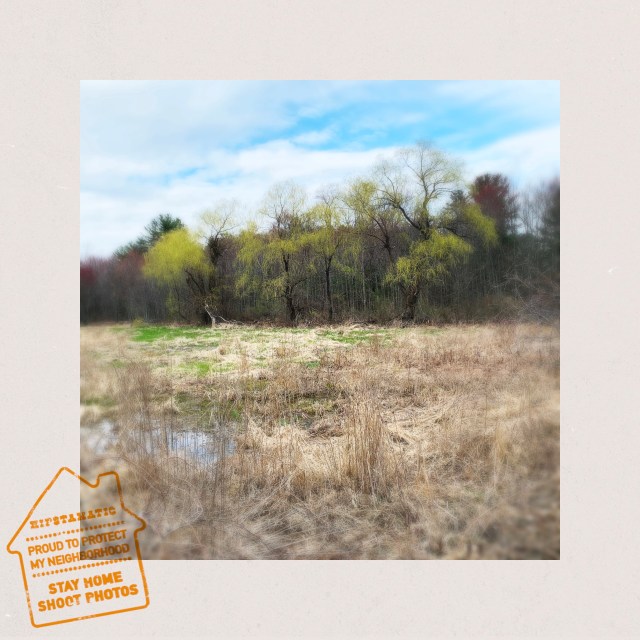
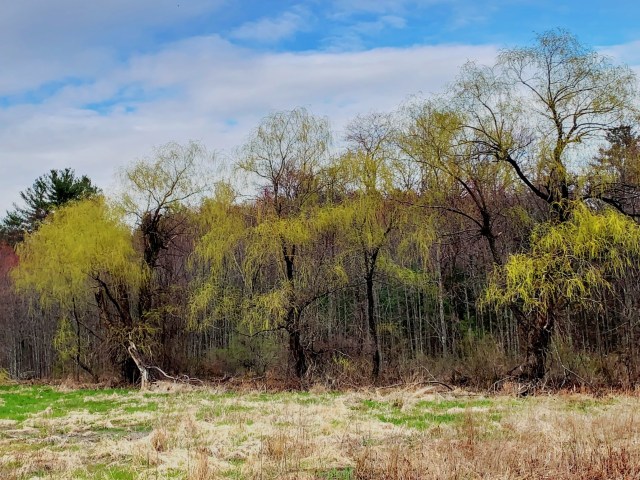
This was another good week, featuring walks on a country road and cooking as we like.  The walk is usually 1.0-1.5 miles down the road from our house and back up again.  We stop for a short rest by the pond at the bottom of the hill.  Here are two watercolor renditions and one “Stay Home” photo along the way.

Waterlogue 1.4.3 (120)
Preset Style = Vibrant
Lightness = Auto-Exposure
Size = Large
Border = No Border

Waterlogue 1.4.3 (120)
Preset Style = Vibrant
Lightness = Auto-Exposure
Size = Large
Border = No Border

Today, however, was mostly about playing in the kitchen.  It was an opportunity to put together more favorite things for lunch.

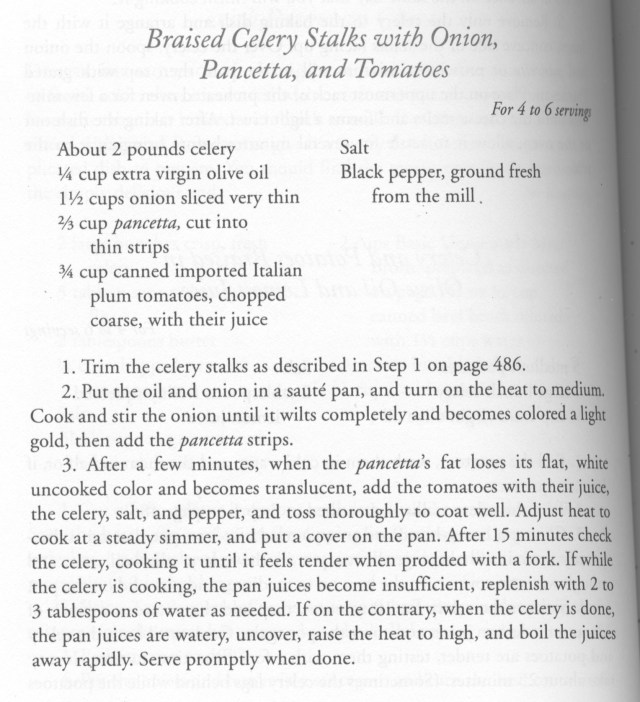
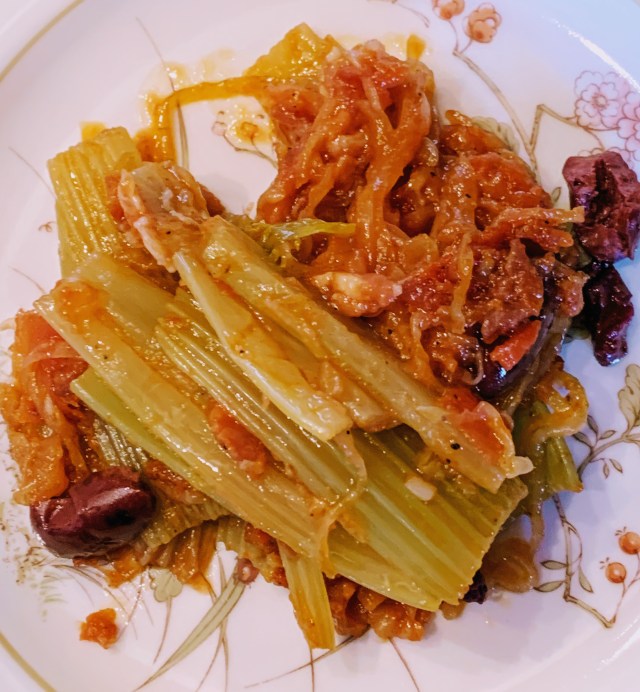
One dish was Braised Celery with Pancetta, Onions, and Tomatoes, per Marcella Hazan.  I actually made it last night, and then saved it for today.  Motivation for this dish was an overabundance of celery, including some mediocre packaged celery hearts I needed to get rid of.  Marcella’s recipe was the perfect solution, especially when I decided to add just one more item to the dish, for saltiness and color: a few Kalamata olives.:

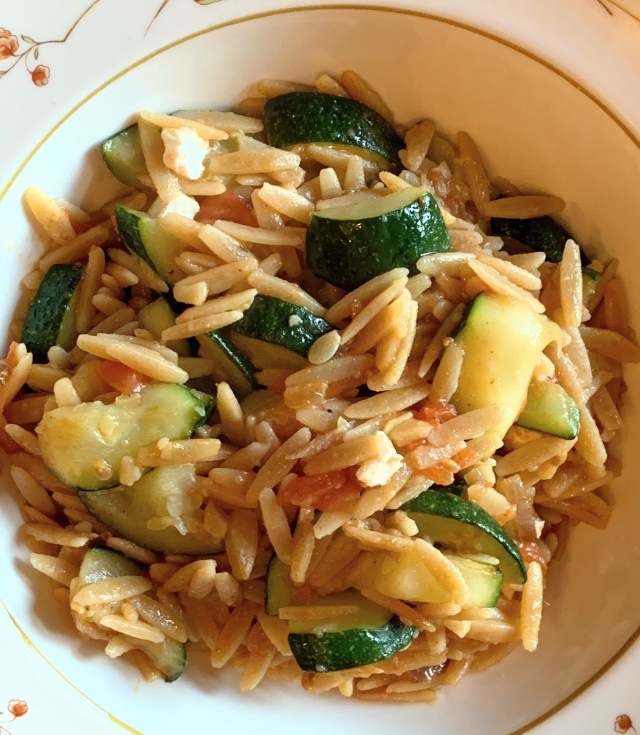
The rest of the lunch was a simple pasta dish, also designed to use what we had available.  This was a whole wheat orzo dish with a sauce of chopped onion, garlic, a piece of anchovy, chopped zucchini, and one peeled and diced plum tomato.  A little diced Israeli sheep milk feta cheese and some dried Greek oregano completed the flavors.

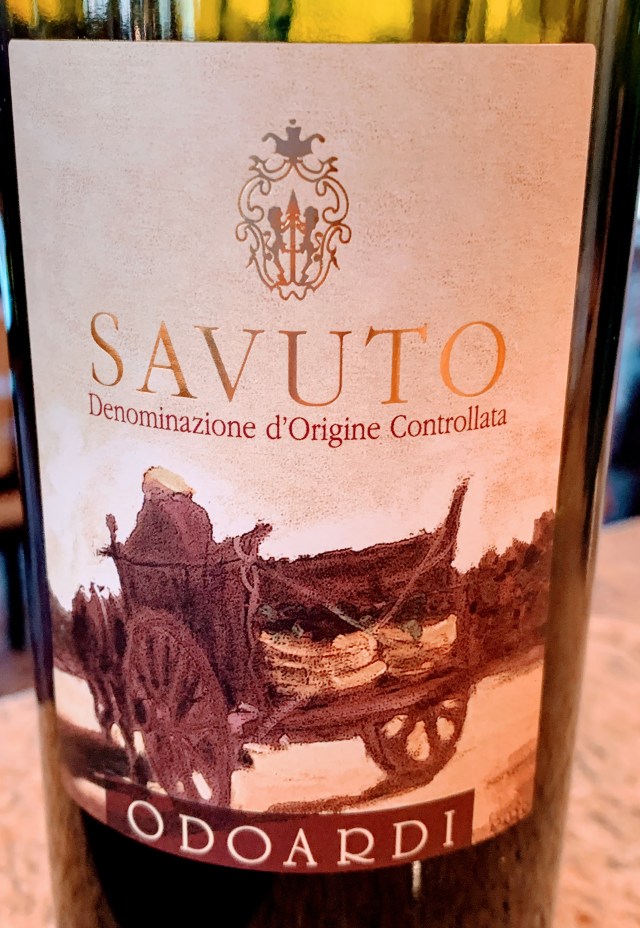
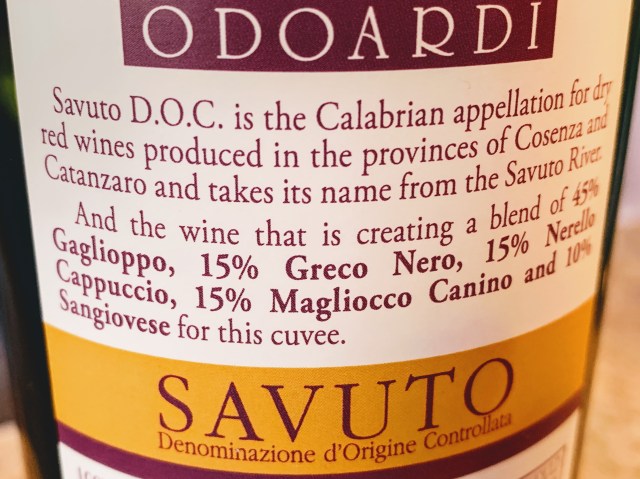
My favorite Calabrian wine, Savuto by Odoardi, imported by Jan D’Amore, went very well.

Posted in Food, Nature, Wine | Leave a comment

Creations: Mine for a Lunch, Barbara’s for a Dinner

Mine: Lunch

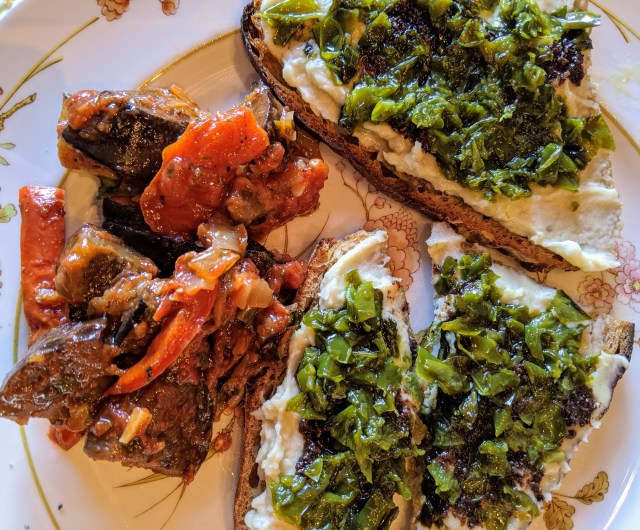
One of the best parts of this “At Home” business is that I always have time and space to create what I want for lunch.  Last Thursday was another in the Bruschetta family of repasts, this time using the few remaining slices of the Overnight Whole Wheat bread I made last week.

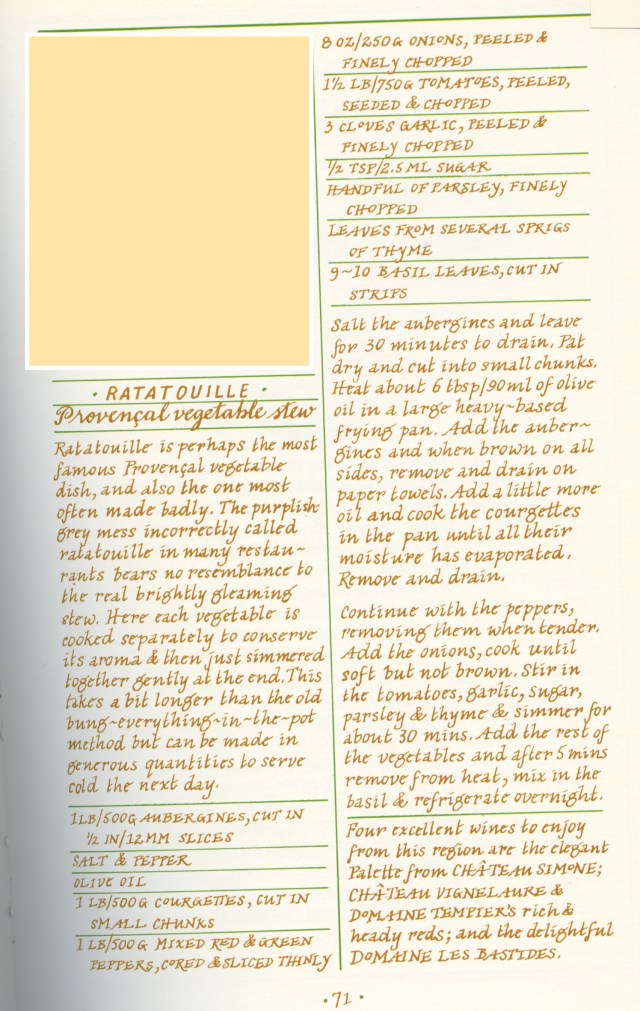
As usual, leftovers played a major role in the affair.  A few days earlier I had made a true Provençal version of Ratatouille.  The recipe came from one of my older and rarely-used cookbooks, A Taste of Provence, by Leslie Forbes, 1987.  It was different than most versions of the dish, in that each vegetable is sautéed separately and then reserved until the final assembly.  It is a masterful touch; the dish was excellent, although next time I will cut the eggplant pieces somewhat smaller and cook them slightly longer.

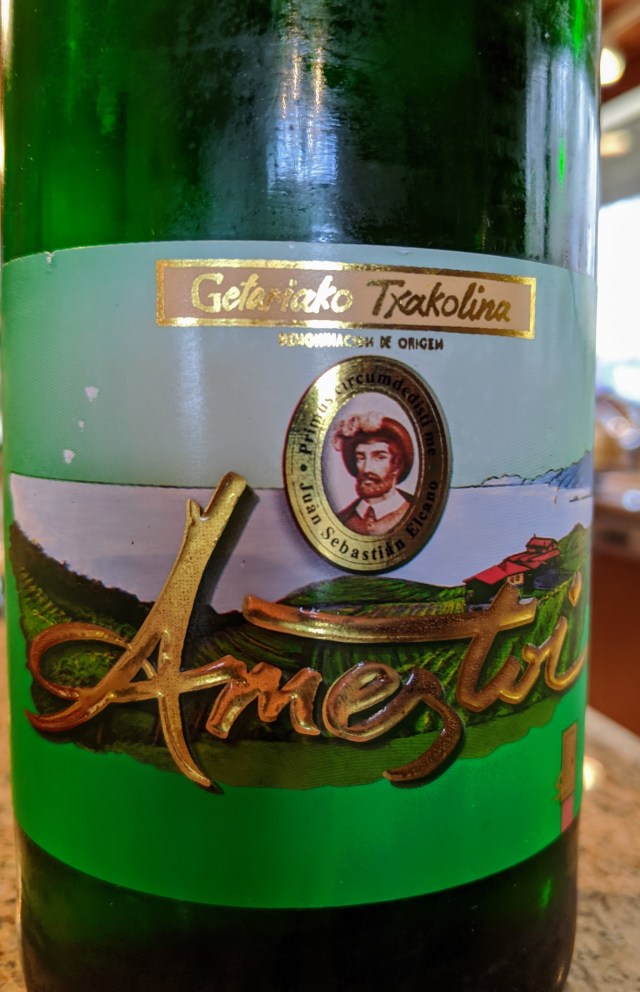
Other leftovers included white bean purée and some seeded, chopped, and sautéed Padron peppers, from earlier in the week.  For the wine, I wanted something sprightly, and I found it nicely in a bottle of Ameztoi Txakolina, from the Basque region of Spain.

Hers: Dinner

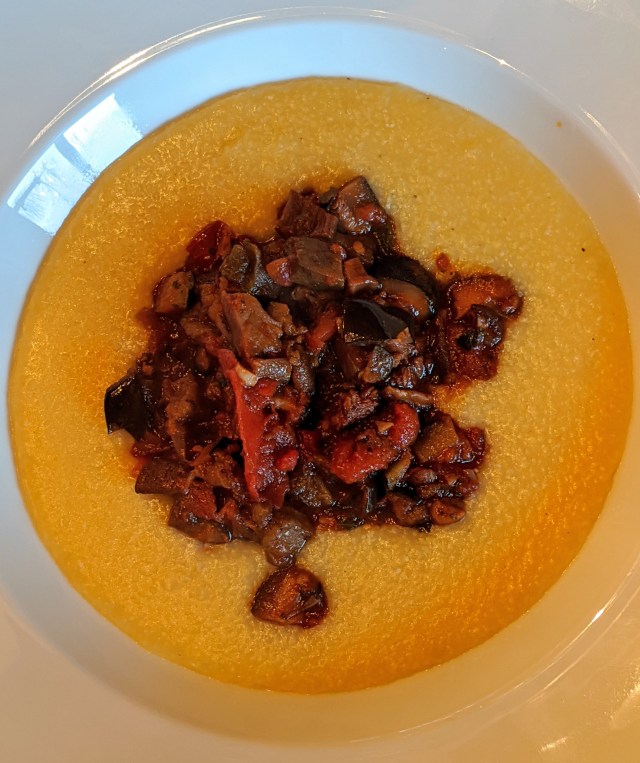
There are a number of things Barbara does better than I do, and high on the list is making Polenta properly.  She uses a great deal more water in the recipe, and she has the patience to stir it for 45 minutes or more.  She also can be very creative in the saucing process.  For this dinner she made a wild mushroom sauce, using fresh Shiitake mushrooms, reconstituted dried mushrooms — Chinese Shiitakes, Hungarian Chanterelles, Italian Porcini — and the reserved liquids from their soaking.  To the chopped mushrooms she added finely chopped leftover Ratatouille (her version, without peppers).  The resulting dish was visually stunning and gastronomically appealing.

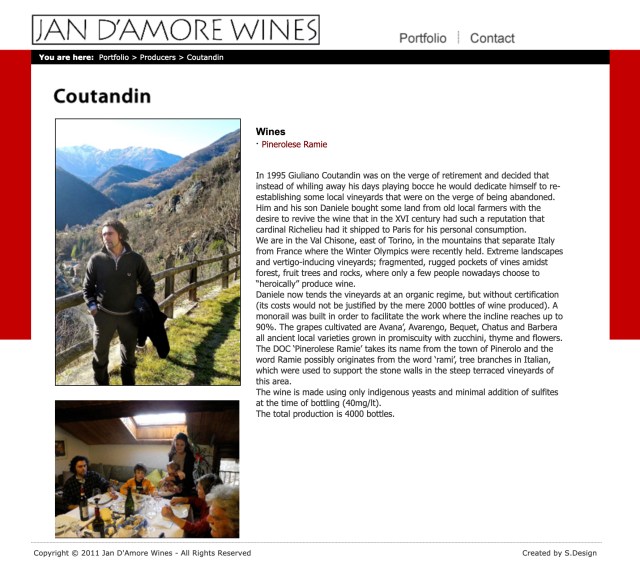
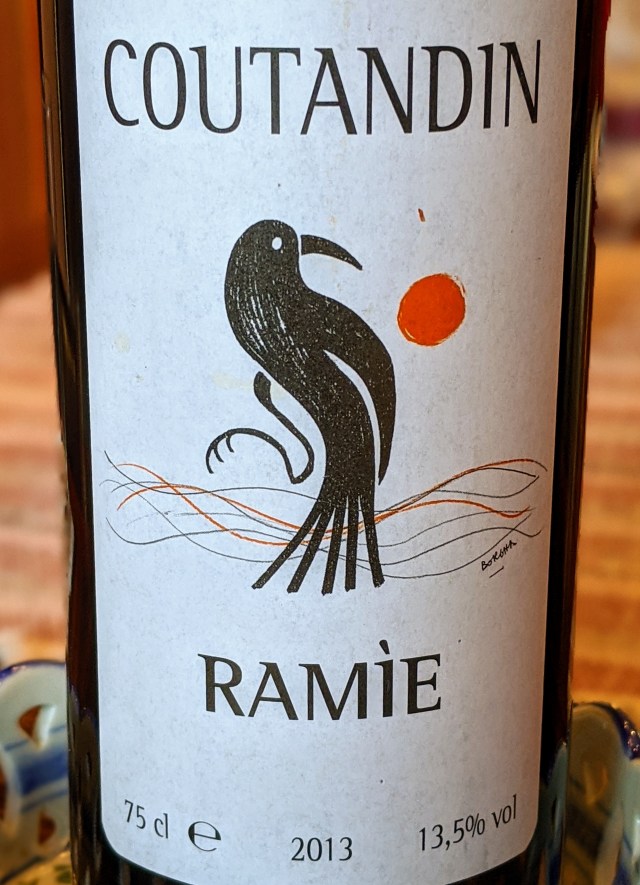
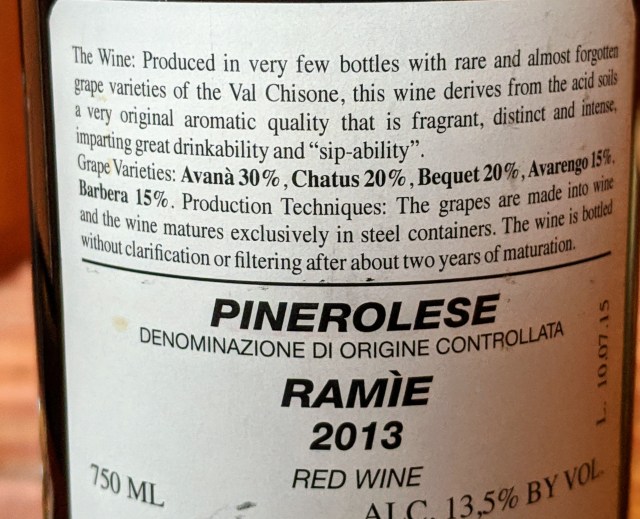
Special dish calls for a special wine.  I chose a Coutandin Ramìe, an unusual wine from northern Piemonte, imported by Jan D’Amore.  I had just purchased a bottle from Eataly Vino.  It was a 2016.  When I went to my cellar to get it, I saw a 2013 bottle on the rack, so I took that one for our dinner.  It was spectacularly good, another tribute to a group of obscure, indigenous grapes of Italy — and the hands of a skilled winemaker!

Posted in Food, Vegan, Wine | Leave a comment

Take Walks, and Eat Leftovers

Sanity these days requires exercise during these crazy, buttoned-up times.  Fortunately, walking along the country road on which we live is accessible, scenic and safe.  Barbara and I often go together during the walk, covering a mile or a little more on a nice day.  As we go downhill toward a small pond, we can often look across a neighbor’s field and see the willow trees as they become green this time of year.  It’s very peaceful.

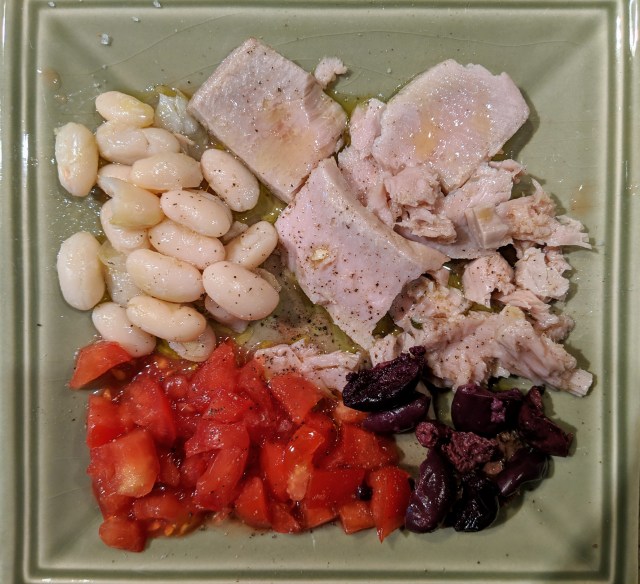
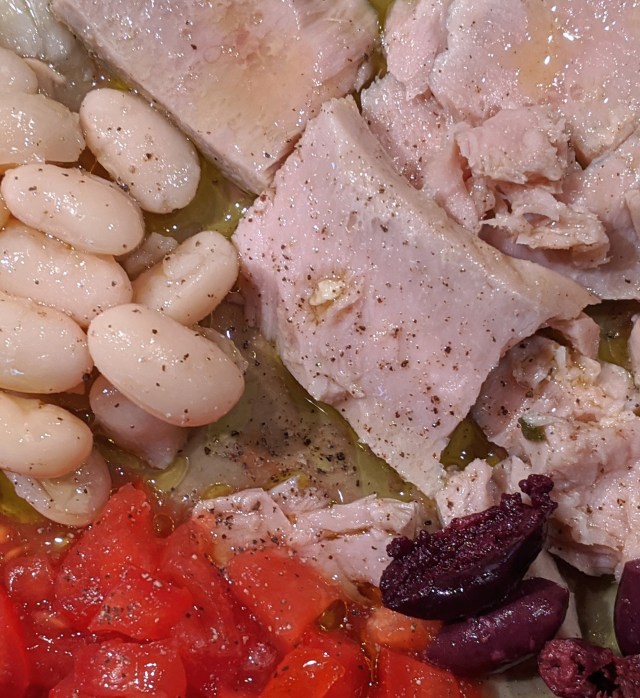
We do get hungry after walking.  Leftovers are usually readily available, and they can be configured quickly into a good lunch.  On this day I made a simple dish of tuna conserva, cannellini beans cooked the day before, a little chopped leftover tomato, and chopped and pitted Gaeta olives.  What really makes a composed salad like this come together in an authentic Mediterranean way is the quality ingredients for dressing: premium Greek olive oil from Kalamata olives, a splash of good Portuguese red wine vinegar, a few pinches of sea salt from Ibiza, and a few cubes of Israeli Feta cheese from Trader Joe’s.

Two white wines were open and cold, so I had some of each: a Polvanera Minutolo from Puglia (imported by Jan D’Amore) and an Argyros Estate Bottled Assyrtiko from Santorini.  Having visited each of these wineries in previous years, I was delighted to have them at my table again.

Posted in Food, Greek food, Wine | Leave a comment

Swiss Chard Frittata — Greens and Ribs

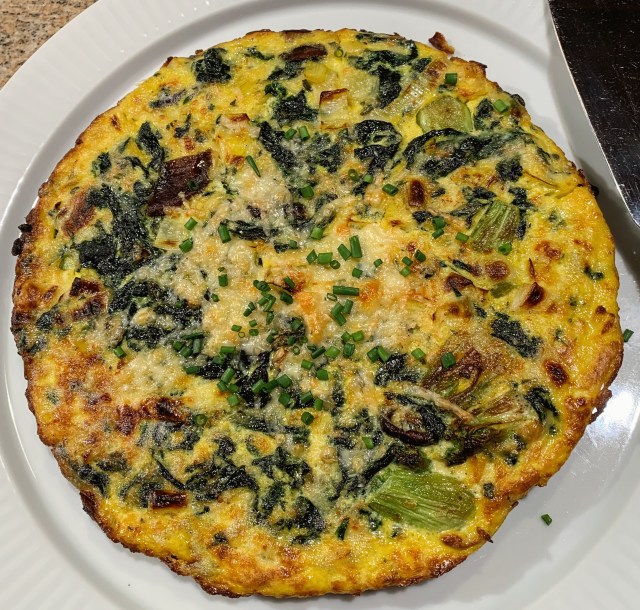
We got some excellent fresh Swiss Chard last week, and it made for a fine dinner Tuesday night and lunch on Wednesday.  Most of the time I use just the Chard greens in my cooking.  However, this bunch had the cleanest, most tender ribs I ever saw on this vegetable, so I decided to use them, too.  Ribs take longer to cook than the leaves — which are stripped off the ribs when preparing them.  Therefore, I cut the ribs across in 1″ pieces,  blanched them in boiling water for 3-5 minutes, and then chilled them in a bowl of ice water to stop the cooking.  I cooked the leaves in a nonstick pan with just a little olive oil, salt, and the water clinging to the leaves after washing.  In essence, the leaves are steamed — covered in the pan over medium high heat, for 2-3 minutes.  After they cool down, I chop them coarsely and mix with the cut up and cooked ribs.

The frittata is easy:

  • crack 5 eggs into a large bowl
  • shred 1-2 cups of cheese into the eggs (we use a combination of Jarlsberg, some French Basque sheep cheese, and grated Parmesan)
  • add a couple of tablespoons of cream, then salt and pepper to taste, and mix all together
  • finally, add the chard leaves and ribs into the bowl and mix well
  • heat a good steel skillet (or a nonstick pan, if you prefer) over medium high heat, add 2 tablespoons of olive oil to the pan, and pour the bowl of ingredients into the pan
  • reduce the heat to medium, and cook, mostly covered, until most of the egg has set — this may take 7-10 minutes
  • take the cover off, drizzle a little olive oil (and a little more cheese if you want) on top of the frittata
  • place in a preheated broiler to brown the top, watching carefully that it does not burn

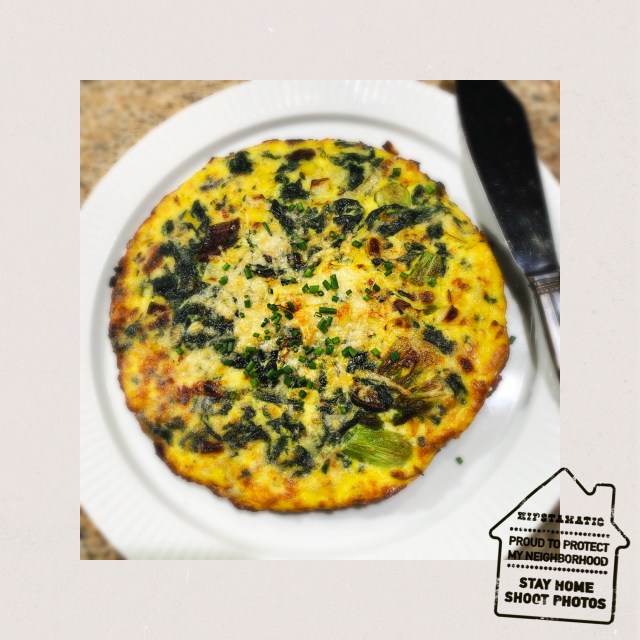
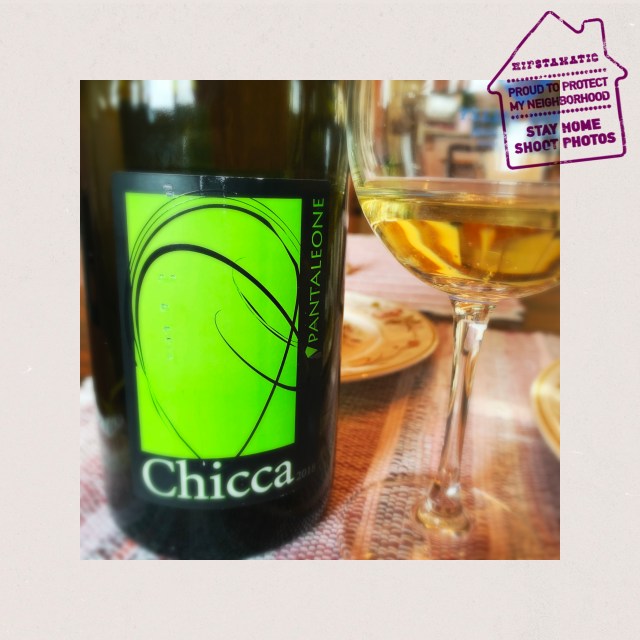
Remove the pan from the oven, let cool a bit, then slide the frittata onto a large plate.  Cut and serve with your wine of preference, white or red.  In my case I chose a glass of Chicca, the Passerina by Pantaleone, which we had earlier in the week.
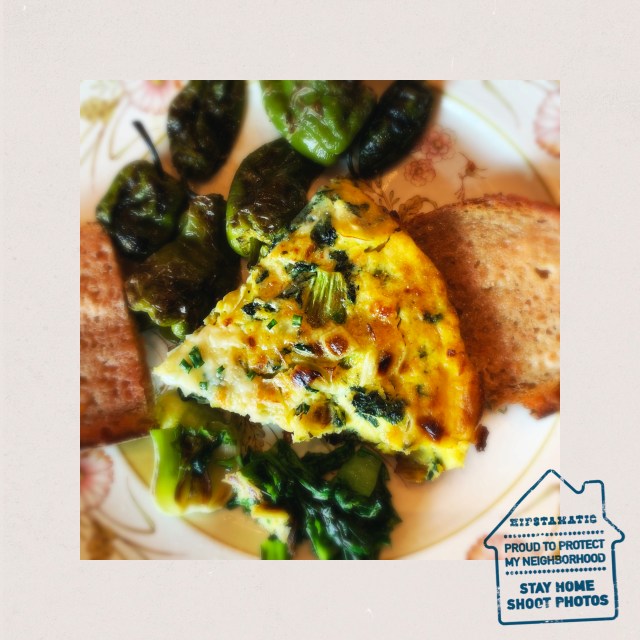
The next day I combined a wedge of leftover frittata with blistered Padron Peppers and a slice of my pan-grilled whole wheat bread to make a delicious lunch.


Posted in Food, Vegetarian, Wine | Leave a comment

Tuna Conserva Once Again

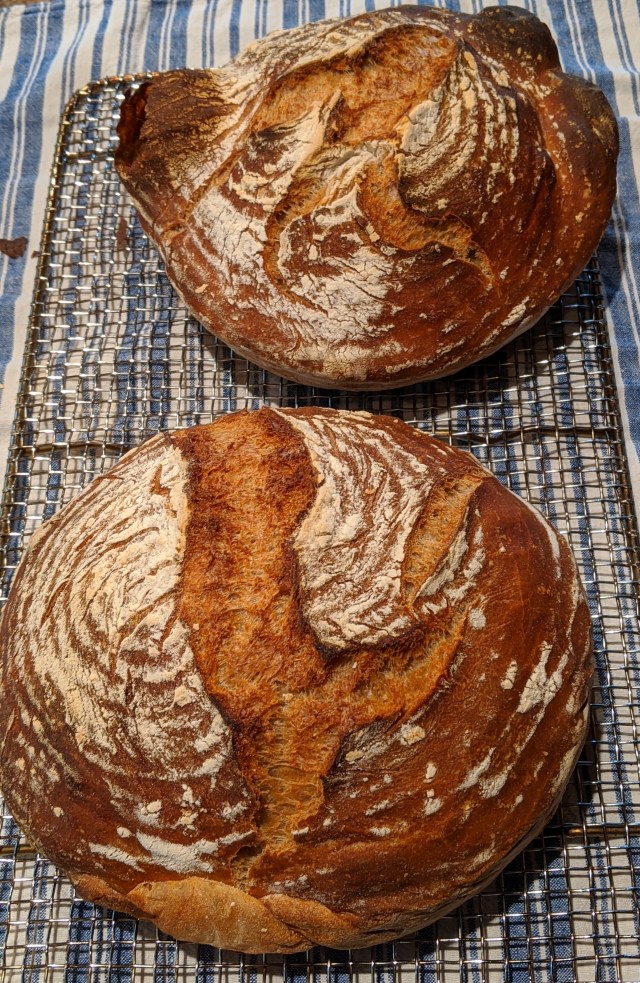
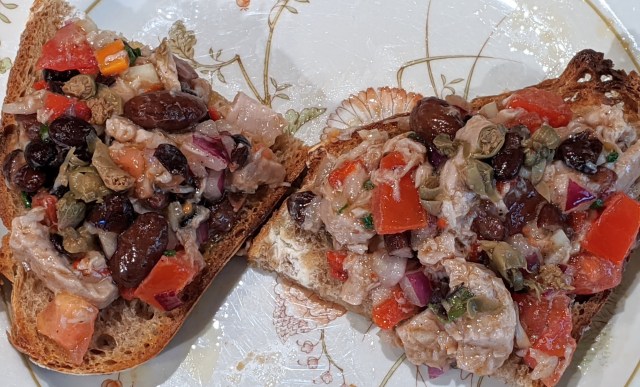
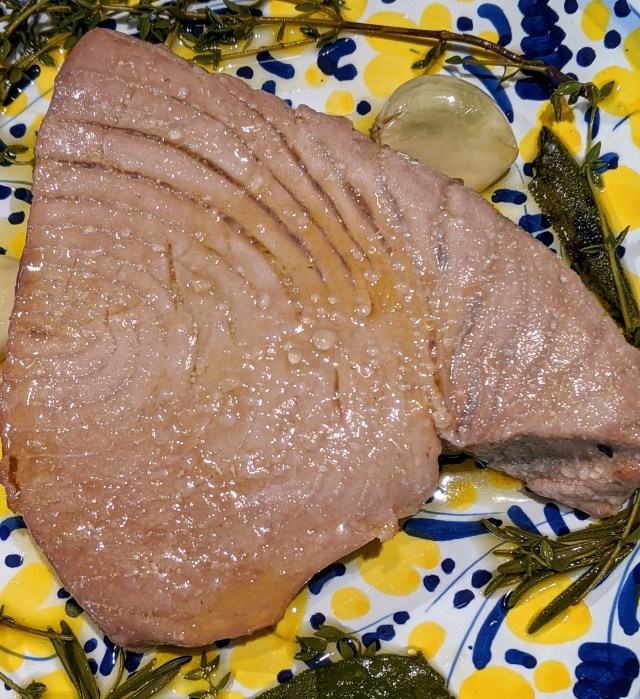
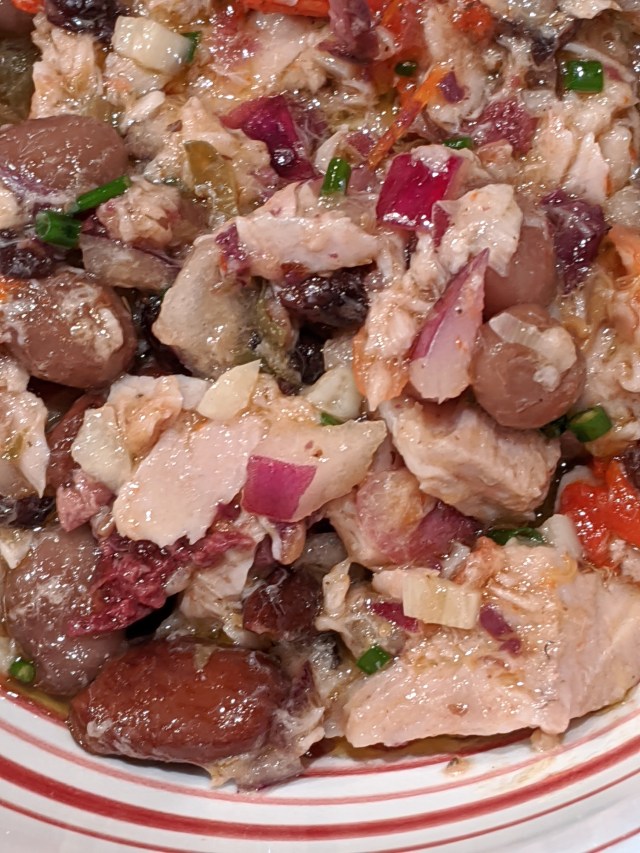
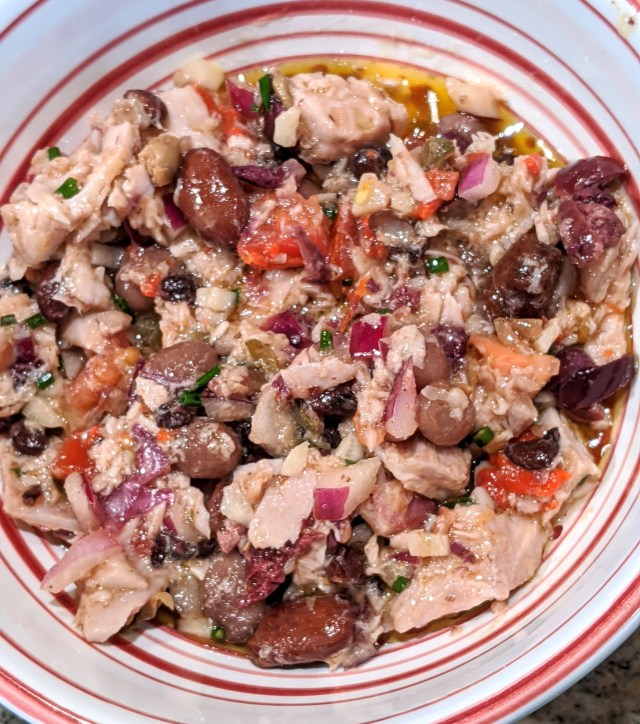
Two weeks ago I made Tuna Conserva.   It was so good, I had to try it again.  This time I made it into a salad — sort of Niçoise — but this time with a medley of cooked beans as well.  The resulting luncheon dish was delicious atop a toasted slice of my Overnight Whole Wheat Bread, baked yesterday.  The bread was a typical Ken Forkish affair over a 24-hour period.  This time (unlike the Field Blend #2) there was no levain involved.  Mix the flours (60% white bread flour, 40 % Red Turkey whole wheat), add water and autolyse.  Then add salt and dry yeast.  Mix and stretch, then let it develop for about 8 hours.  Form the two loaves.  Put them in bannetons in the refrigerator overnight.  Bake in 475° F. oven until crispy and brown.

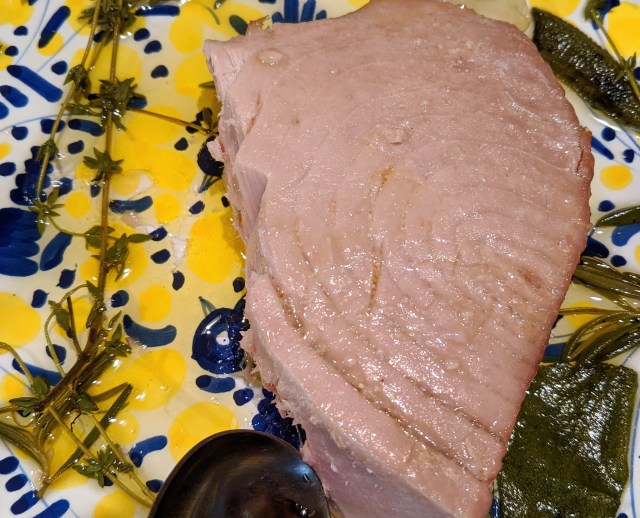
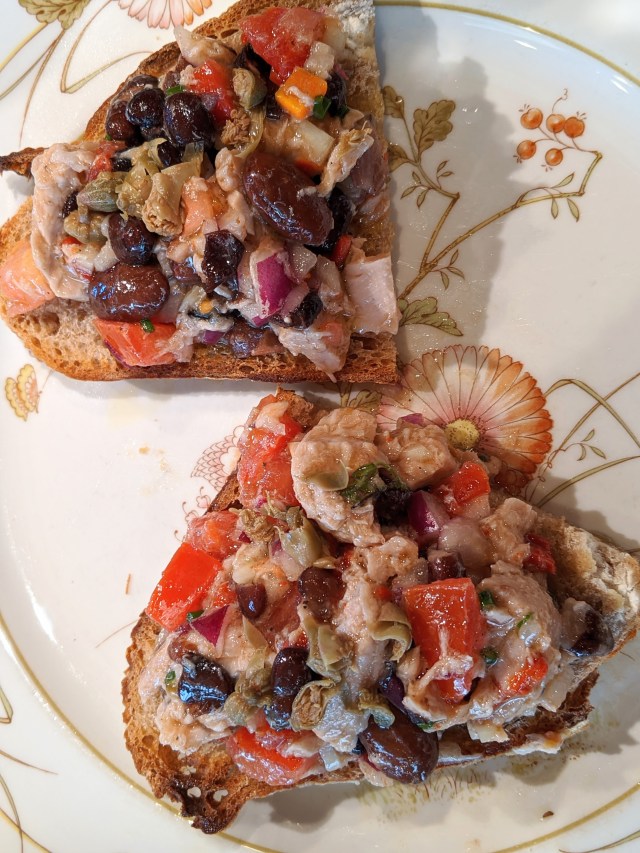
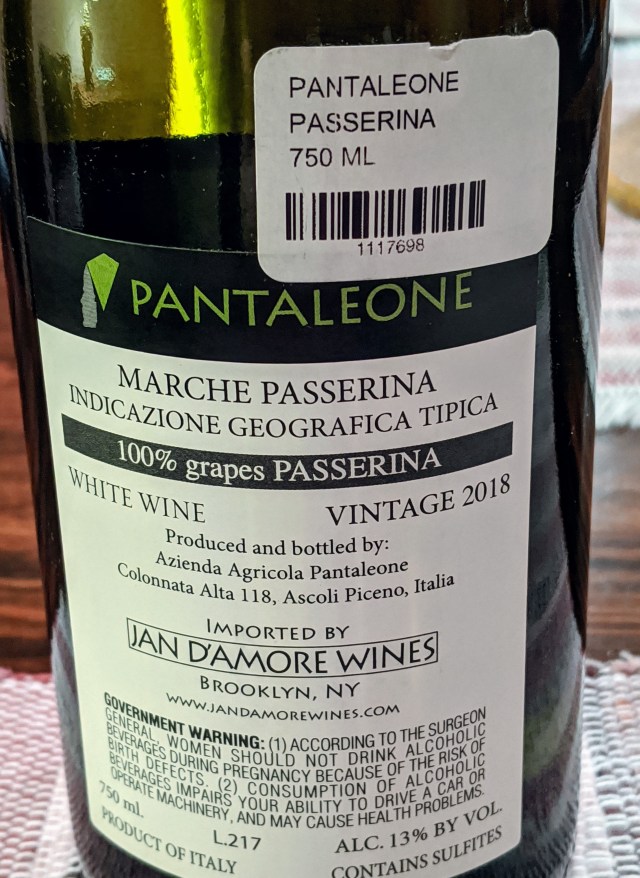
Poached the tuna as before, this time with more herbs: garlic, thyme, rosemary, and sage.  Cooked enough in 7 minutes, then relaxing in a bowl of the poaching olive oil overnight in the refrigerator.  Today at lunchtime all I had to do was flake some of the tuna into a large mixing bowl, add a small bowl of leftover cooked beans from the Farro and Bean soup the other day, and then add 1/2 plum tomato and a few slices of red onion, finely-diced.  Additional ingredients included one diced piquillo pepper, a handful of pitted and chopped Gaeta olives, some chopped Santorini capers, a splash or two of Portuguese red wine vinegar, and several tablespoons of the oil from poaching.  Toast the bread, top with tuna mixture, and serve.  A glass of 2018 Pantaleone Passerina from the Marche region of Italy was a perfect accompaniment.  This is about as Mediterranean as you can get, with elements from Southwestern France, Spain, Portugal, Italy, and Greece.

I believe it’s one of the best dishes I ever made.  Thank goodness there’s more in a bowl for lunch tomorrow.

Posted in Food, Wine | Leave a comment

Spanish

My relationship with all things Spanish is decidedly mixed.

On the one hand, we have the benefits today of the great food and wine for which Spain is appropriately famous.  Many of those glories have been the subject of posts in this blog.  For example, none of the meals I’ve made with the Spanish octopus this past week would have been possible without them.

On the other hand, we have a number of lessons from the history of Spain.  Most impactful from my point of view were the actions of the Spanish king and the Catholic Church in 1492.  While Americans are familiar with that date because the explorations of Christopher Columbus, 1492 was important in a different way for all Jews and Muslims in Spain.  Virtually all of those populations were tortured, killed, or forced to convert to Catholicism – and later expelled from the Iberian peninsula.  Jews had lived in Spain for about 1500 years, and they had enjoyed peace and prosperity during the Golden Age of Spain, when the Moors ruled from 711 to the late 1300’s.  That was a period of co-existence and collaboration among the three major religions, and it was a remarkable time of significant scientific, artistic, and economic achievements.

After the “Reconquista” Spain was a great world power, but its colonial success was marred by the brutal ways in which the empire destroyed indigenous peoples all over Latin America, while plundering their resources.  This part of the history was in the forefront of my experiences when I visited Chile in 2001 and Peru a year later – my first trips to South America.

Finally, people my age and a bit older have memories of the Spanish Civil War and the subsequent despotic rule of Generalissimo Franco in the years that followed.

You probably read this blog for food, wine, and travel information, so let me move on to those topics – now that you understand the background of my occasional ambivalence about Spain.  Having visited Barcelona several times, Galicia, the Spanish Basque region, Palma, Ibiza, Grenada, Gilbraltar, Priorat, Montsant, and Tarragona — all in the last 24 years — I do now have an appreciation for Spain and its many good qualities.

All of this is background to the final meal from a fine 3.7 lb. Spanish octopus purchased last week and documented in my last five postings here.

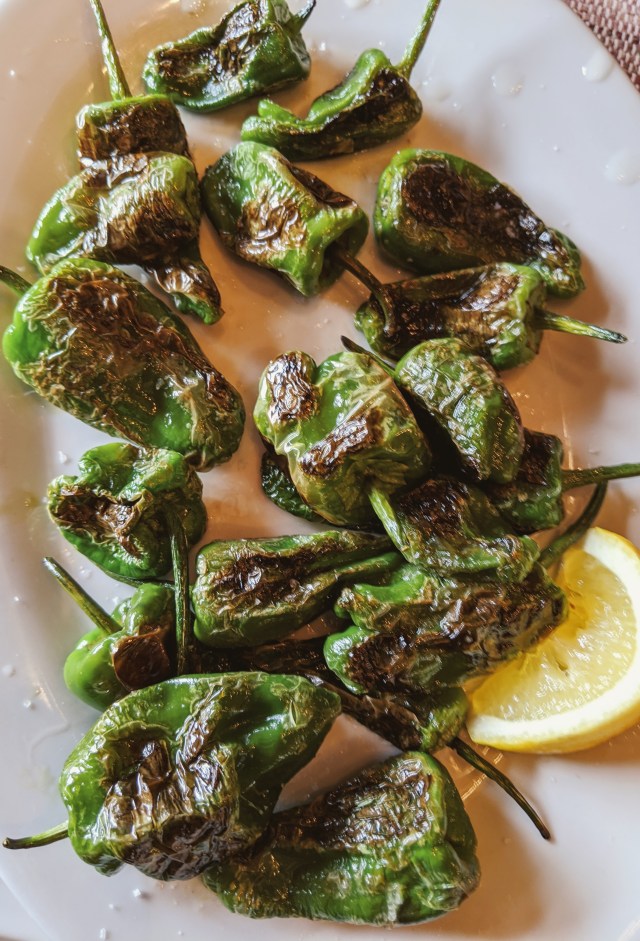
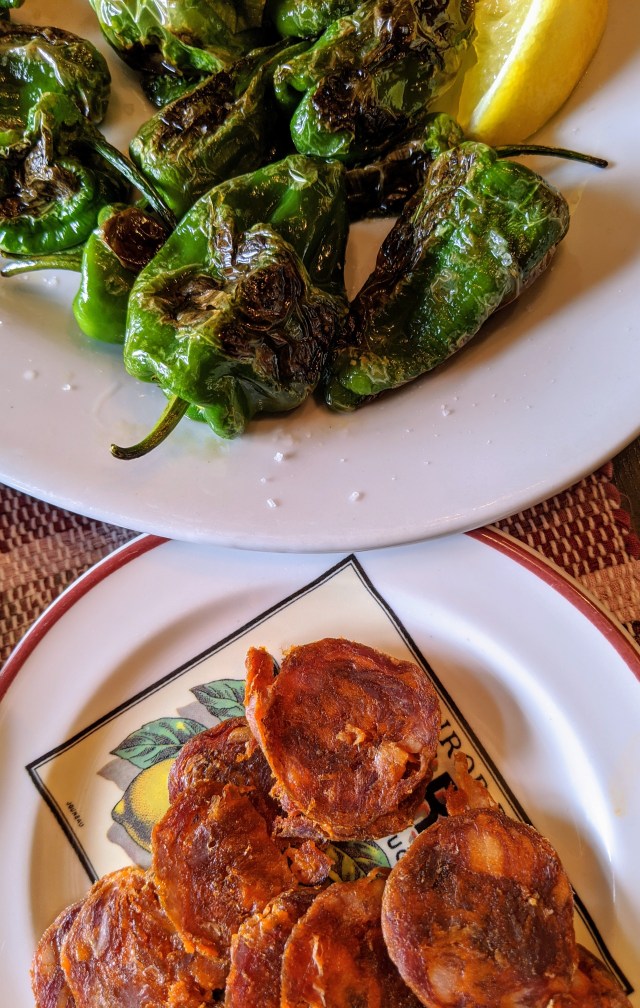
Once again the meal of interest was lunch, since I can make what I want and not disturb Barbara, whose food choices can be quite different than mine.  And — like yesterday — simple preparation was again the theme.   Today the design was Spanish, including side plates and other ingredients.  Yesterday I received an order of Spanish delicacies from La Tienda.  They included Padron Peppers (which you have seen several times here before) and Chorizo (a very non-vegan, non-Kosher treat I eat on rare occasions — like during a pandemic).

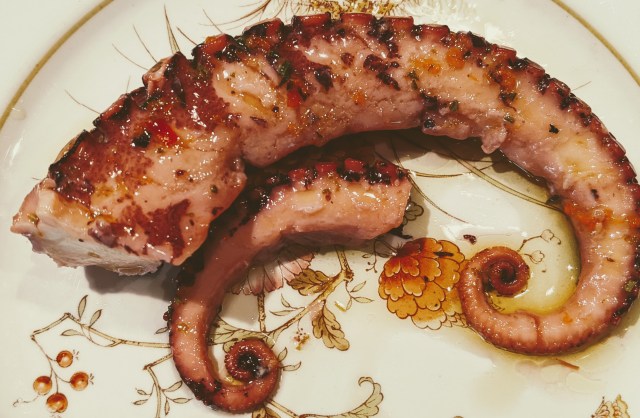
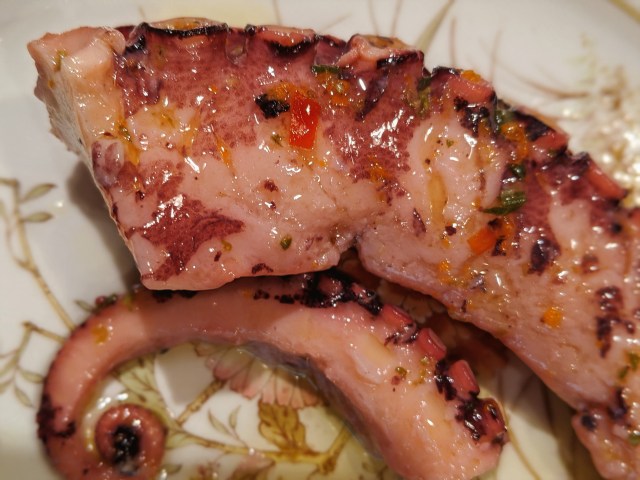
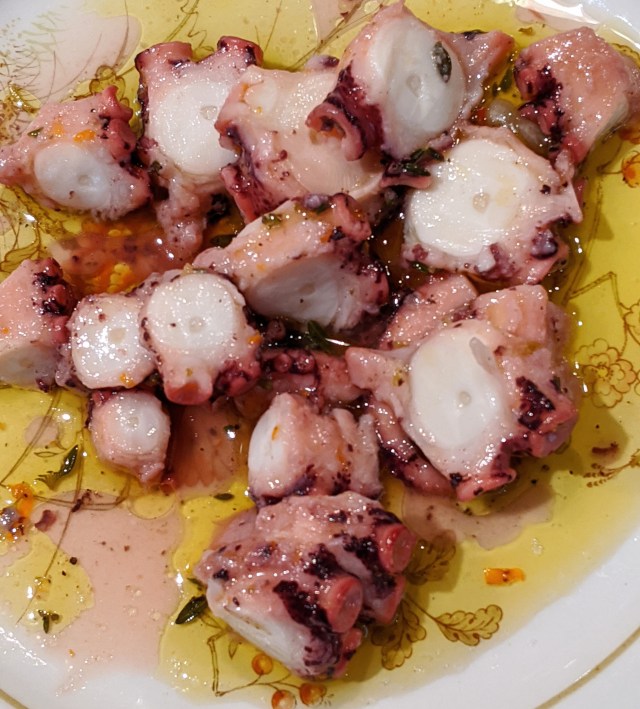
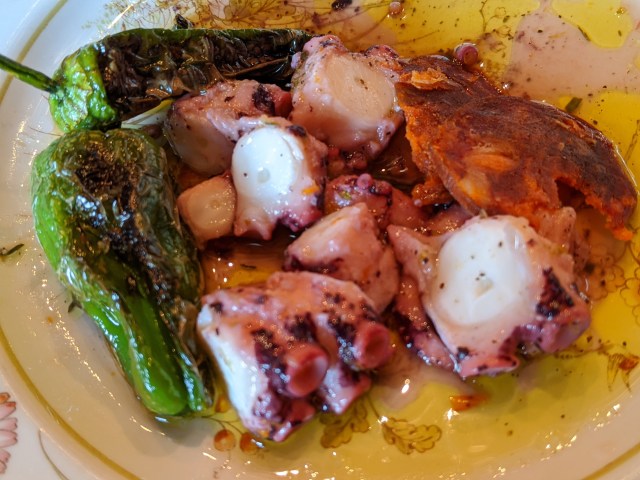
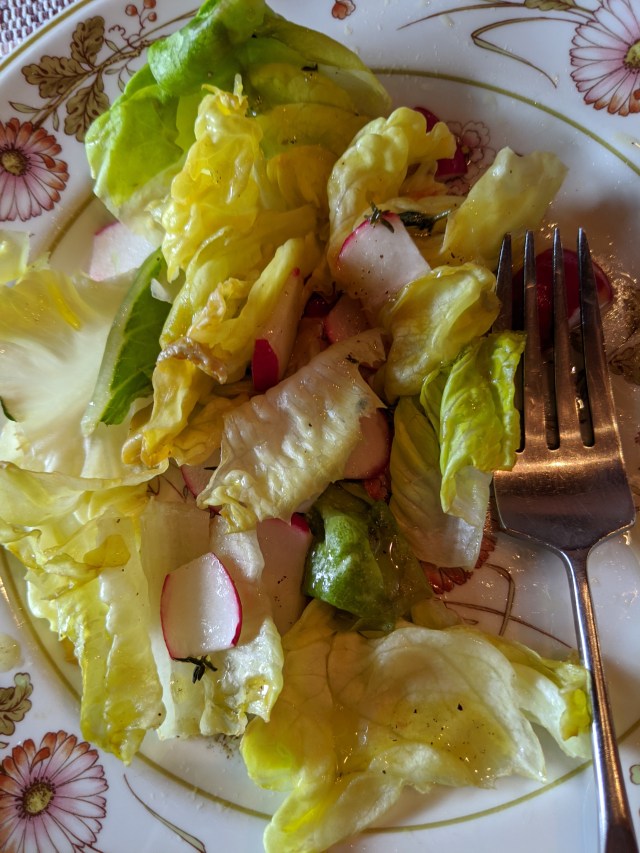
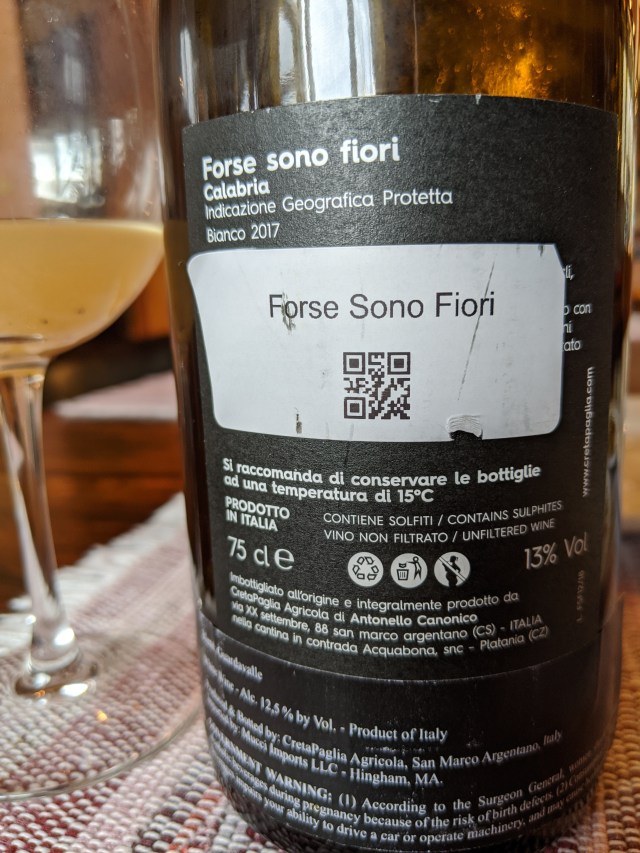
After removing the last leg and a half from the olive oil marinade, I charred it on a gas grill, coated it with a garlicky vinaigrette, blistered the Padron Peppers in a cast iron skillet, dusted the peppers with Maldon salt, plated the leftover green salad with radish from last night’s dinner, and thinly sliced some of the Chorizo as a side dish.  Since it was lunch I did not go all-out for Spanish wine.  Instead I chose to finish an open bottle of a orange Calabrian wine — Forse Sono Fiori — by CretaPaglia, one of Nick Mucci’s growers.  It was beautifully-matched to the vinaigrette.
Thank you, octopus.  You were great, all the way.

Posted in Food, Travels, Wine | Leave a comment

The Next-to-Last Meal from the Spanish Octopus — Greek-Style

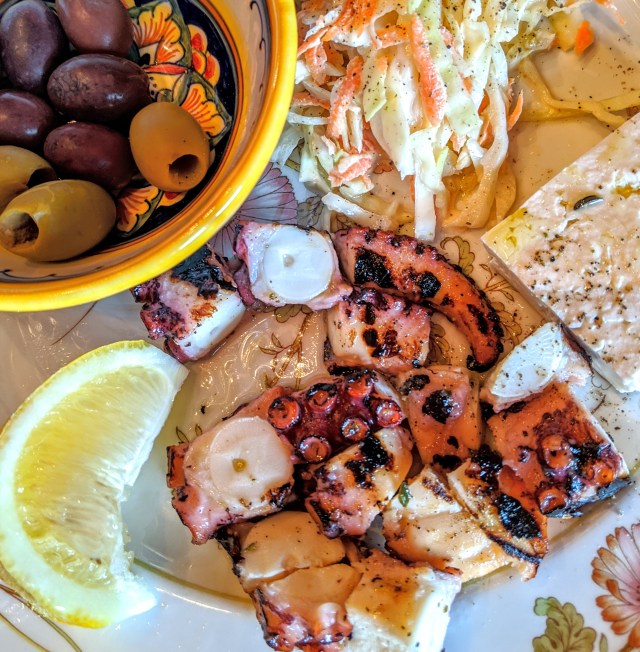
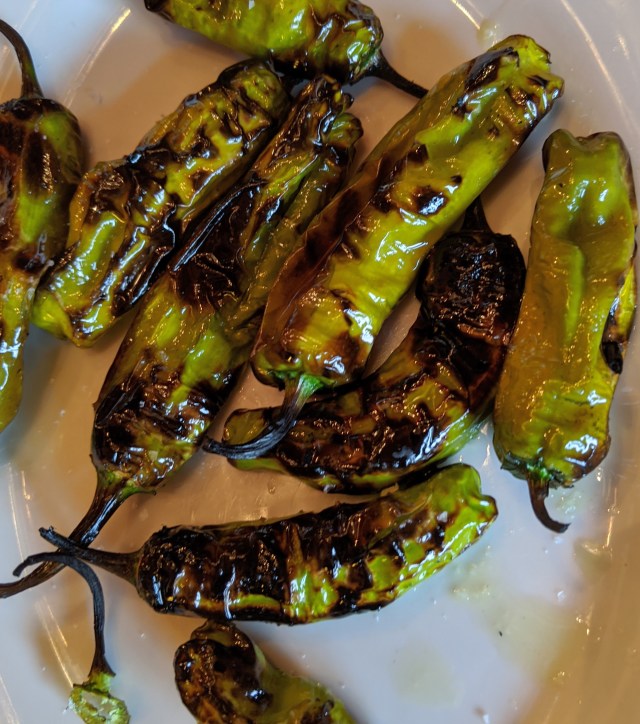
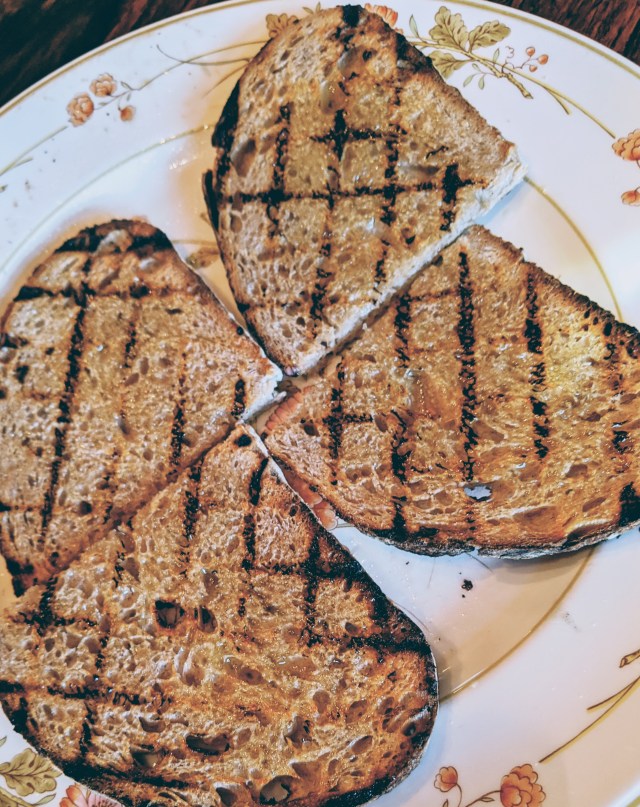
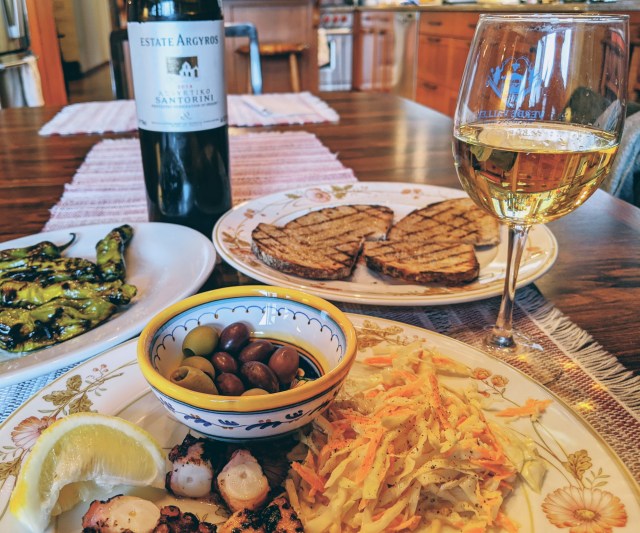
Lunch on Friday was a simpler affair with my friend, the octopus.  I decided to minimize the cooking, so I did what one might do for lunch in Greece, with these tentacles on hand.  I gathered up typical side dishes for such a meal — a little leftover cole slaw, a chunk of Feta cheese, some olives, a wedge of lemon, slices of grilled country-style bread, Shishito peppers, and a bottle of the best Assyrtiko wine from Santorini.   Then I grilled a large octopus leg, added good Greek olive oil, and sat down to a satisfying lunch.

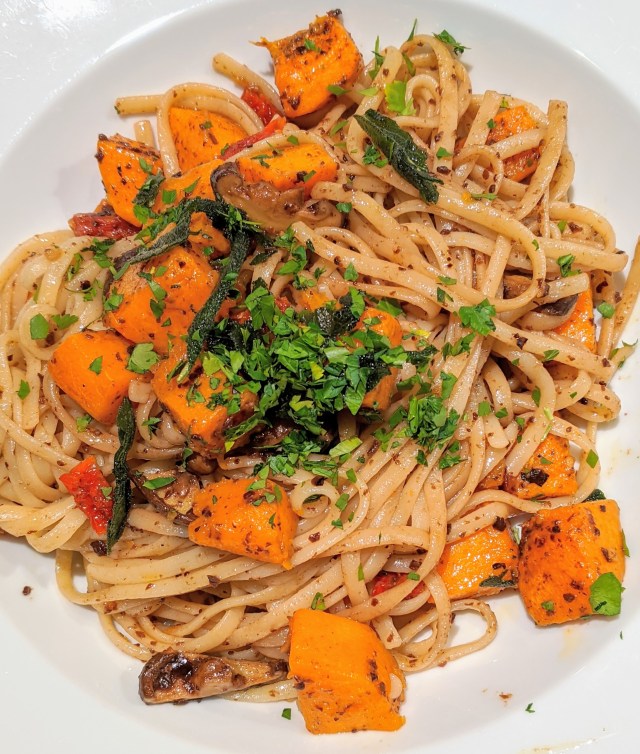
Thursday (the previous night) was also my night to cook.  Just for the record, I prepared a meal of Linguine with Roasted Butternut Squash, sun-dried tomatoes, Shiitake mushrooms, and a sauce made with mushroom broth and hot water from the cooked pasta.

Posted in Food, Greek food, Uncategorized, Wine | Leave a comment

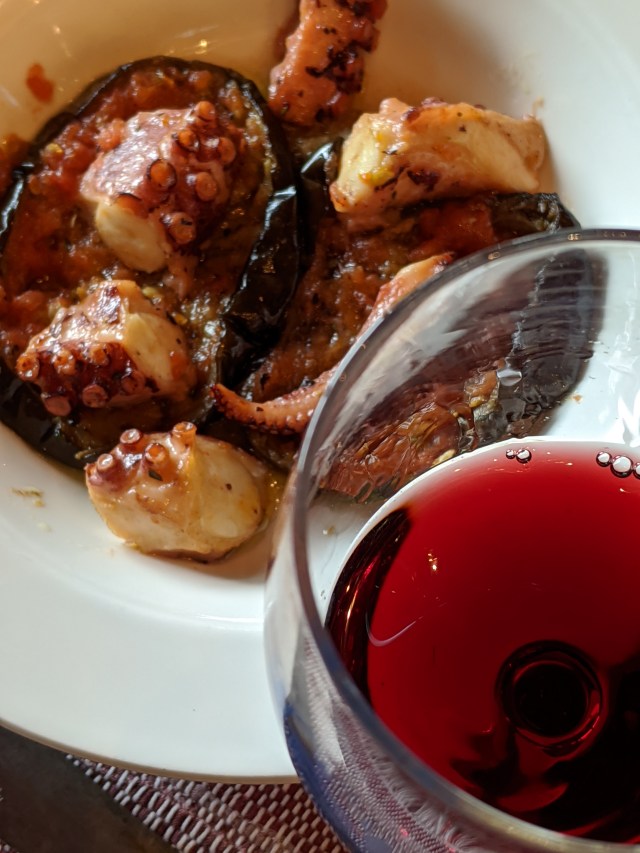
Three Eggplant Slices, Two Octopus Tentacles, One Grated Tomato, and Lots of Olive Oil

There’s almost no limit to the range of wonderful recipes using Octopus.  Today’s lunch is the third one I’ve tried in the past three days, and perhaps the most delicious.

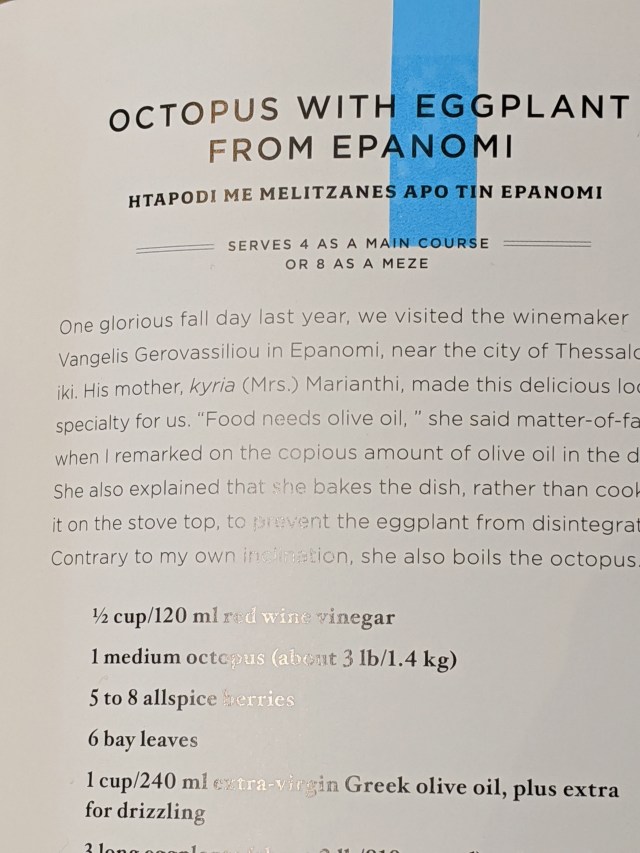
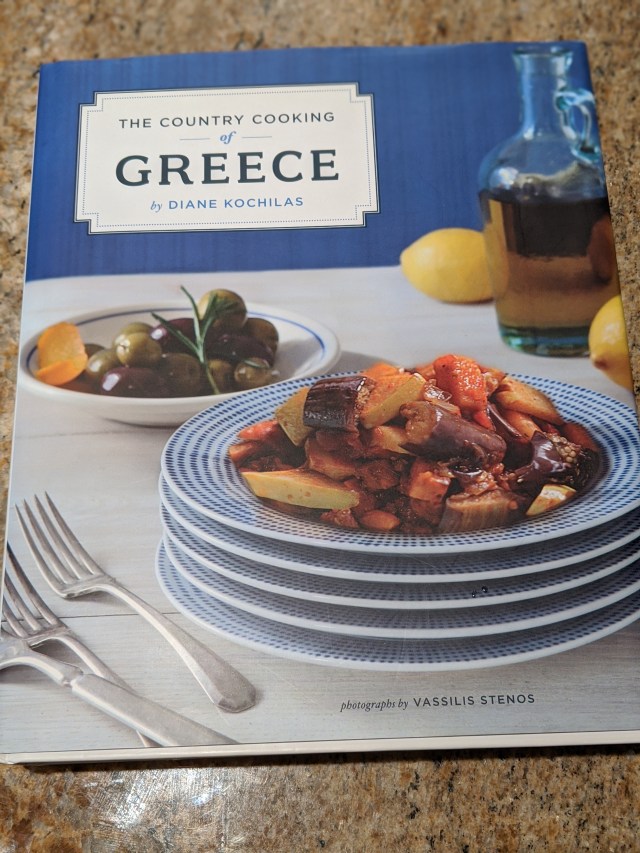
This recipe is from The Country Cooking of Greece, by Diane Kochilas.  She describes a dish of Octopus with Eggplant from Epanomi, near Thessaloniki.  I won’t give the full recipe because I already had cooked the octopus, so I’ll just give you the essence of the final dish.

Last weekend we made pizza, so we had some leftover toppings, as usual.  I had cut up a medium eggplant, and had roasted the pieces in the oven so they were tender, but not quite fully-cooked (which would take place on the pizza, when that was in the oven).  We had three slices remaining in that mostly-done condition.

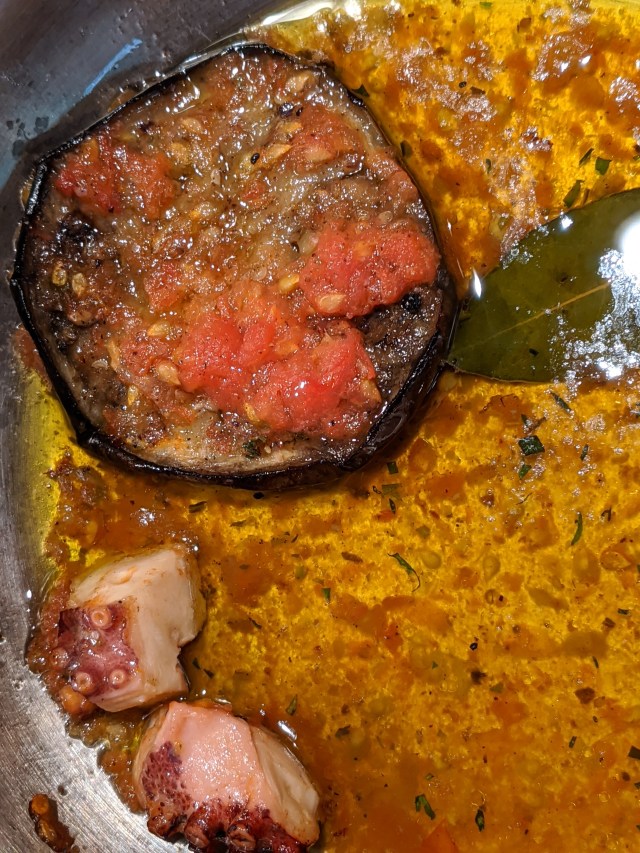
Two days later I cooked a 3.5 lb. Spanish octopus, and that was marinating in the citrus-herb infused olive oil ever since.  All I needed to create a small version of this recipe was a grated fresh tomato, a Greek bay leaf, a baking dish, and a 350° F. oven, all readily available.  The dish encouraged liberal use of olive oil, so I used the marinade freely.
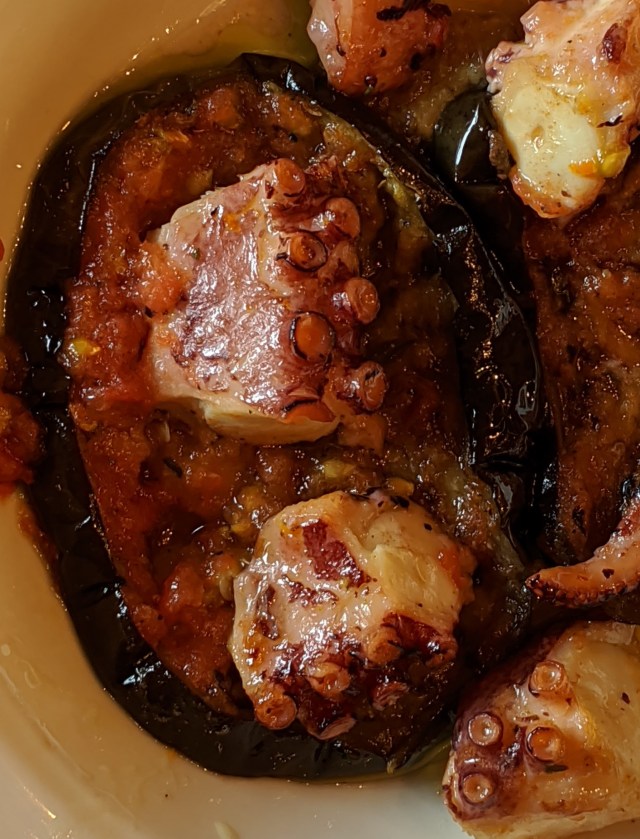
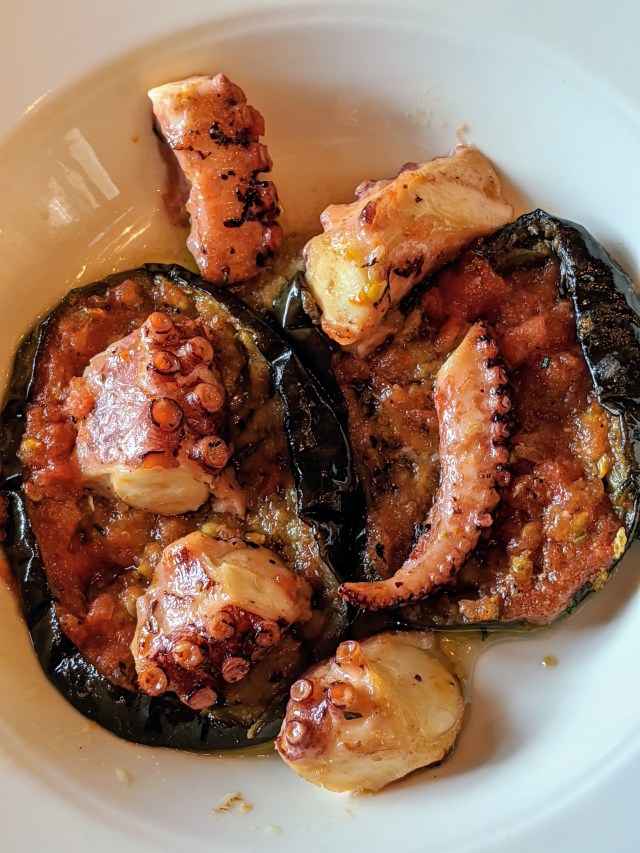
Here’s how it looked in the gratin dish, and then on the plate:

My friend, Dean, had come over briefly yesterday and had left me a gift (at 10 feet away) of a red wine, a Montepulciano d’Abruzzo, which splendidly complemented the rich flavors.  Thank you, Dean!!

Posted in Food, Greek food, Wine | Tagged | Leave a comment

Octopus, Potato, and Green Bean Salad

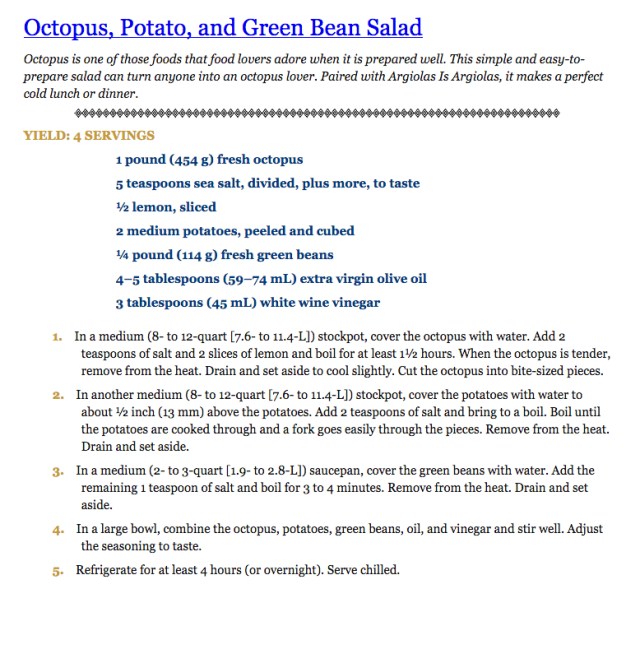
The novelty of having tender, cooked octopus resting comfortably in a bowl of olive oil in the refrigerator — ready to be turned into a meal in a flash — has not yet worn off.  Today’s version was inspired by this recipe which was in The Sardinian Cookbook I purchased last Fall:

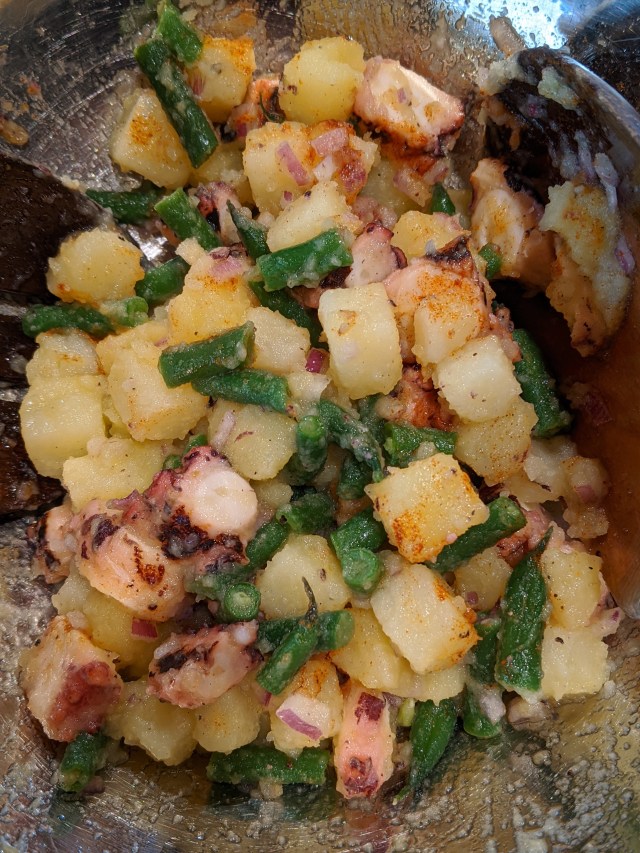
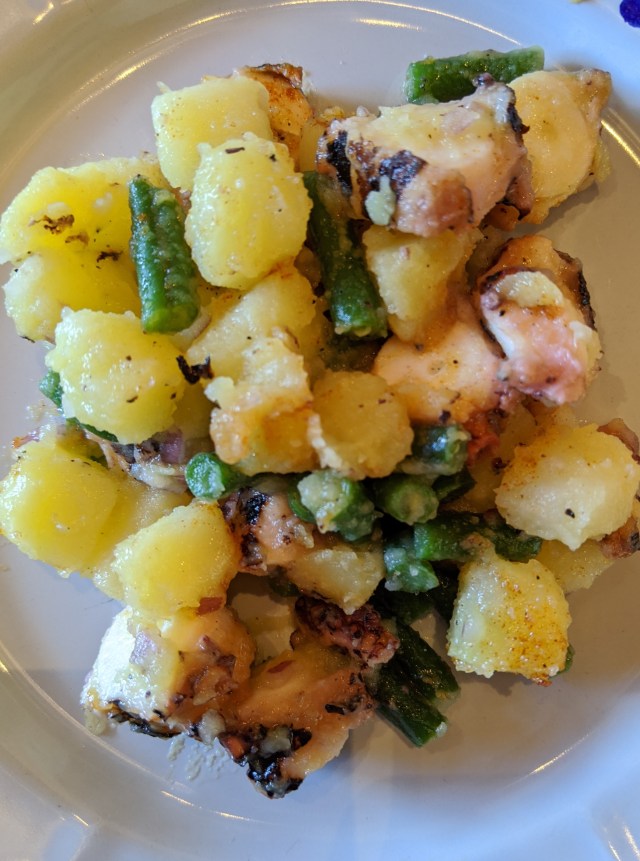
Of all the ways I cook and eat this mollusk, my favorite technique usually involves grilling.  I used the basic idea of the recipe above, after having used my gas grill on two tentacles, before I incorporated the slices into the salad.  Two other modifications: lemon juice instead of white wine vinegar, and served still warm, rather than the cold salad as described.  (I did chill the leftovers, so I’ll sample that tomorrow.)

You will note that I also grilled a slice of my Field Blend #2 bread to accompany the dish.  It is interesting that I had opened a bottle of Argiolas Vermentino from Sardinia last night, and it was perfect with this dish.

Posted in Food, Wine | Tagged | Leave a comment