Ode to the Octopus

An octopus is a remarkable creature.  It appears to be one of the most intelligent beings on the planet.  It also happens to be a delicious and very healthy food, which is what initially interested me the most.

I have close friends who won’t eat octopus because they feel it’s wrong to to use them as food, and I have some respect for that point of view.  However, as a vegetarian/pescatarian, I don’t eat that much of it; the fishery appears to be quite sustainable; and it’s my favorite source of Vitamin B-12.  And it tastes great, when prepared properly — which is the subject of today’s post.

Like most of us we are quite constrained on our shopping these days, so I took advantage of an online resource — Browne Trading Co. of Portland, ME — to buy some seafood last week.  I have been to their store when I visited Portland in the past, and I know their products are outstanding.  One item was a frozen 3.5 lb. Spanish octopus, and today was the day I cooked it.  That required taking it out of the freezer yesterday and letting it defrost for 24 hours at refrigerator temperatures.  Fortunately, outdoor temperatures have been in the 35-44 degree range for the last few days, so I was able to leave it out on the porch to defrost (that’s my walk-in refrigerator.)

I’ve learned over the years that there are three major steps in preparing octopus for the table after defrosting:

  • poaching it until tender
  • marinating it while hot, to enhance flavors
  • preparing the finished dish, which could involve cutting, grilling, pairing with other ingredients, and plating

I have had good luck with the first two steps by following this video by Jessie Schenker:

so that was my approach today.  In the past I found it difficult to maintain the 190-200°  poaching temperatures on the stovetop for over an hour, so I tried to be scientific and to use the oven — after properly calibrating the temperatures.  I filled a deep pot with hot water, brought to 195° F. on the stove, set the oven temperature to 200° F., and came back an hour later to see if the target temperature had been maintained.  Nice theory, but no luck.  The water in the pot had dropped to 176°, so clearly the oven was running 20-25° cooler than its setting.

Proud of my detective work, I figured the cure was to increase the set temperature to 220°.  I put the octopus and all the aromatic flavorings in the pot and put it in the oven, confident that it would be close to the 195°-200° target.  When I checked everything 45 minutes later, I was disappointed to find that it was still too cool.  My digital thermometer read 180°, and the octopus was not going to achieve the desired level of heat.  It was still underdone.

At this point the pot was on top of the stove, so I decided to use the burner instead, and to watch it carefully.  Over the next 45-50 minutes, I kept measuring the temperature in the pot, keeping it between 187° and 194°.  That seemed to work.  Removing the octopus from the pot, I checked the tenderness and decided it was done.  Immediately, it went into the bowl with olive oil and flavorings as a marinade and then left to cool the rest of the day.
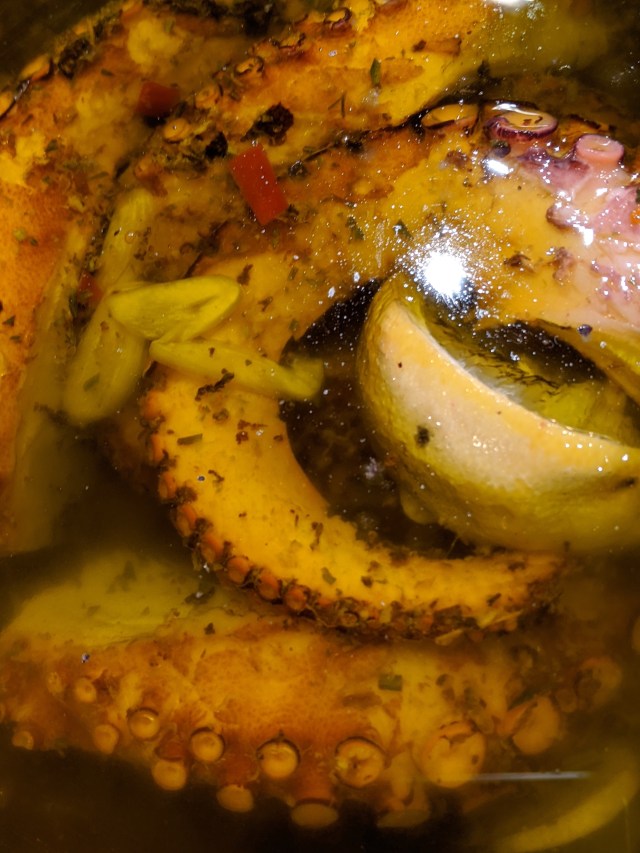
Cooked Octopus Marinating in Olive Oil and Seasonings

After dinner I started to think about all the dishes I planned to make this week.  After all, there are 8 legs to work with.  One of the approaches I found in my research was this video by Eric Ripert, chef and co-owner of Le Bernadin, the spectacularly good seafood restaurant in New York.
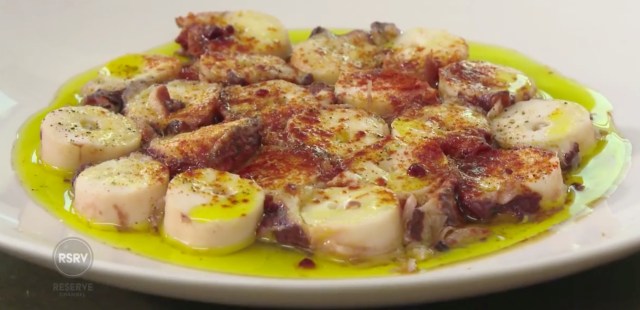
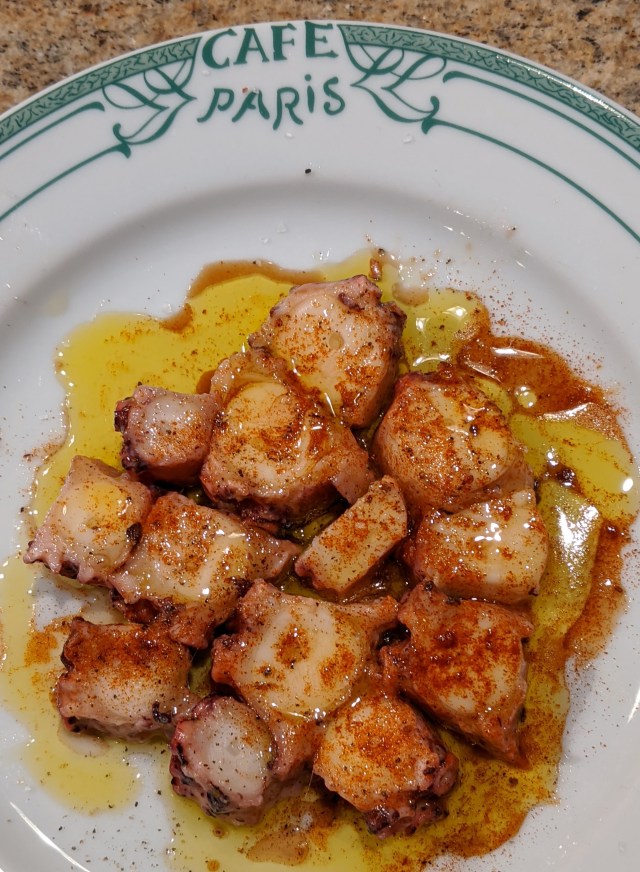
Having marinated the octopus for more than 6 hours, I was ready to try it.  I took it out, cut one leg off, sliced it as Eric described, and followed his seasonings carefully.
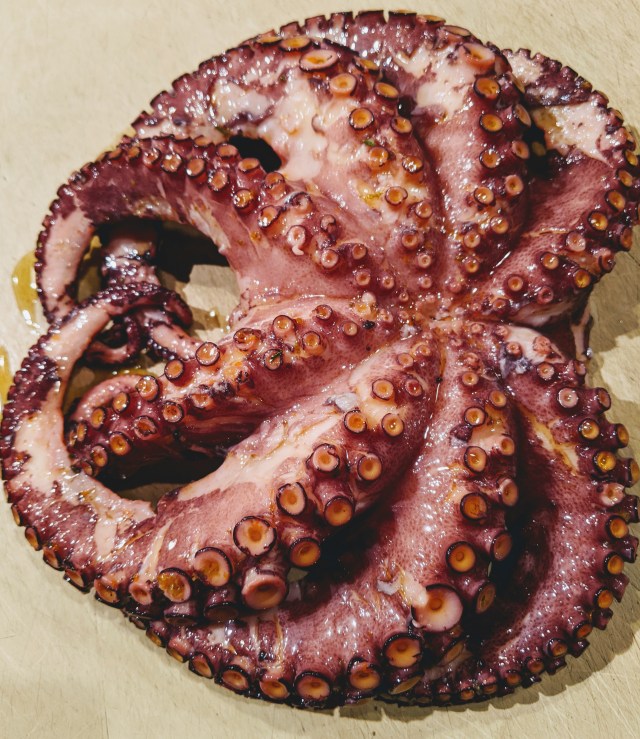
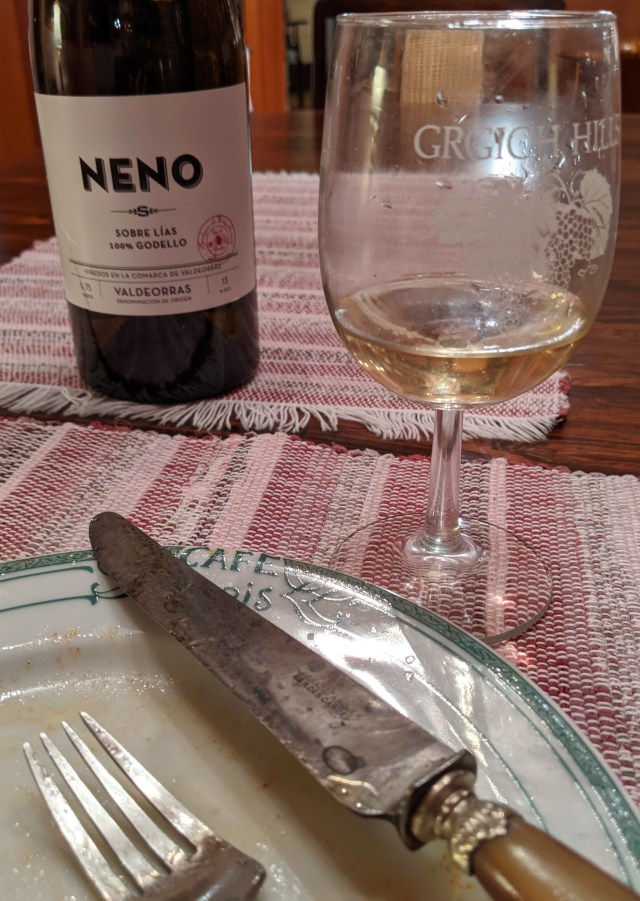
Perfectly marvelous!  I felt like I was enjoying a tapa in San Sebastian, accompanied by a very charming Godello.  Merci, gracias, Eric.
Posted in Food, Uncategorized, Wine | 2 Comments

Wood-Fired Homemade Pizza: Signs of Spring

We have been looking for a warmer day in March to crank up the wood-fired pizza oven, as a harbinger of Spring again.  Today was the day, with temperature slowly rising from the mid-40s F. in the morning to mid-50s by 2 PM.  The first use each year is a longer affair, since the oven collects moisture during the winter, so much of the heat generated by the burning wood goes into evaporating that moisture over the first two hours.

It took about three hours to get the fire good and hot.  Once it gets there, the flames can be mesmerizing.  Here’s an example:

Of course, as thrilling as that fire can be, its main purpose is to make great pizza.  Once again, this oven does that very well.  We made 5 pizzas, sharing one for a neighbor.  The best combinations were:

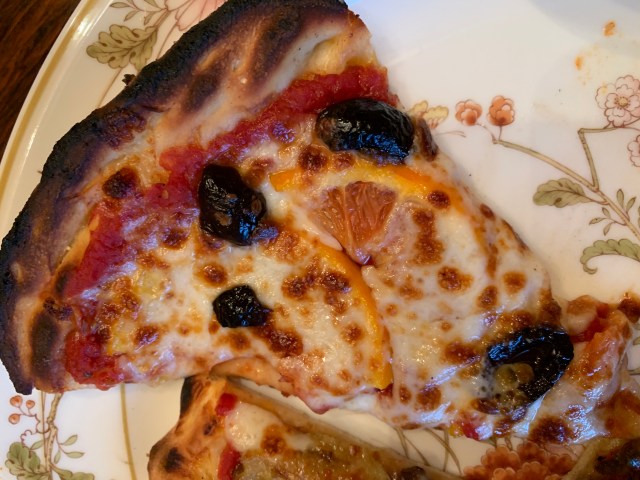
  • thinly-sliced oranges with oil-cured black olives, tomato sauce and cheese
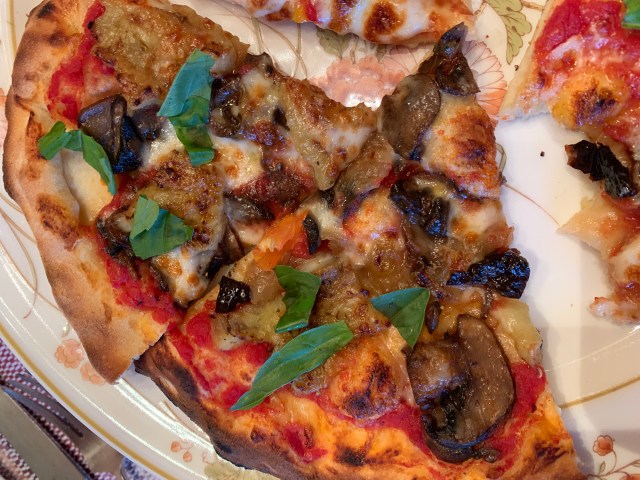
  • oven-roasted eggplant, caramelized onions, pesto, sautéed mushrooms, basil leaves, black olives, tomato sauce and cheese

Orange slices and black olives pizza

pizza with caramelized onions, mushrooms, roasted eggplant, tomatoes and cheese

Posted in Food, Vegetarian, Wine | Leave a comment

Tidbits

Some of my best meals are made with leftover components from dishes made earlier in the week.  Such is the case for today’s lunch.

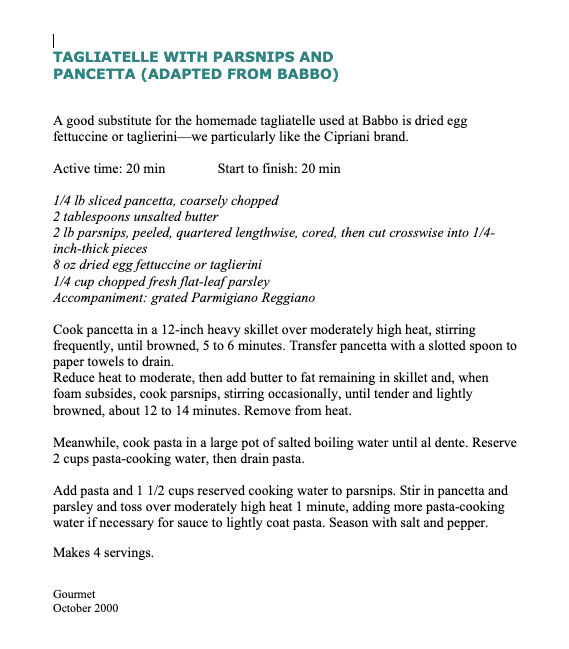
I had a small package of Black Trumpet Mushrooms (my newly-annointed favorite mushroom), but it was almost past its prime, so I had to use it in today’s lunch.  Yesterday I made fresh pasta for Tagliatelle with Parsnips and Pancetta for dinner.

I have been using a recipe of these proportions: 100 g. of flour, one extra large egg, salt, and some olive oil.  The results have been excellent using about 2/3 double-zero white flour and 1/3 whole wheat flour (especially organic heirloom Turkey Red brand, purchased from Breadtopia online).  Normally, I double the recipe for the two of us.  The 100 g. version is too little, and the 200 g. version is too much, so we normally have leftover tagliatelle.  I let the remaining pasta dry on the counter overnight, and then refrigerated it, so it was ready for lunch today.  That was Tidbit #1.

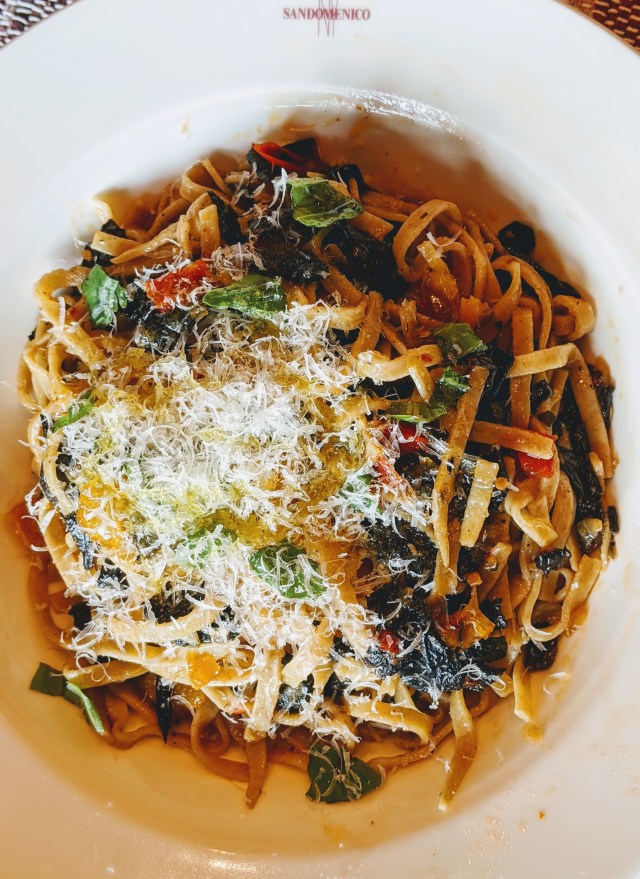
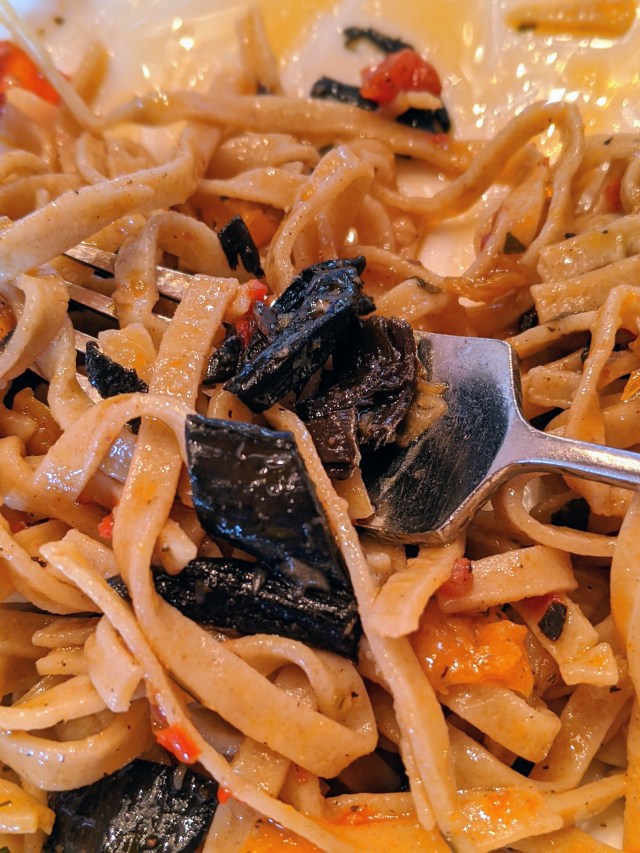
My plan was just to sauté the Black Trumpets in olive oil and butter, then mix with the pasta and serve.  However, after boiling the noodles, I put some aside for Barbara’s lunch, so I had to supplement the dish for my own meal.  I also wanted to add more color (just black and white can be dramatic, but this is just a casual Saturday lunch…), so I perused the refrigerator shelves and found another leftover — the pepper sauté from Puglia, very colorful and flavorful in a complementary way — that was Tidbit #2.

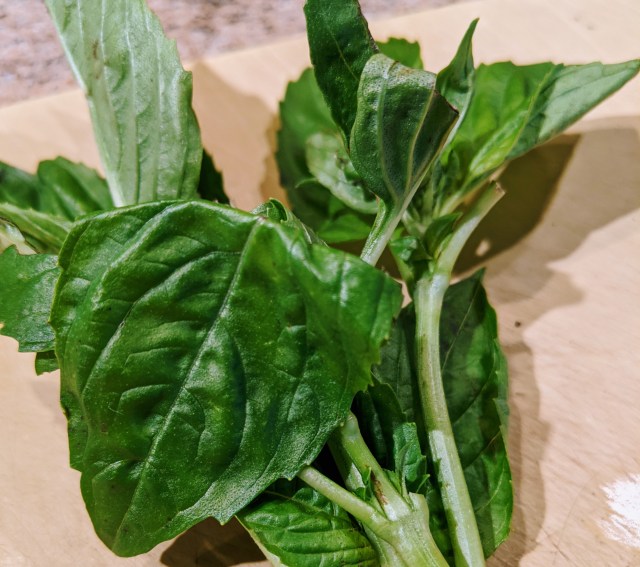
The last element to add was simply a few torn fresh basil leaves.  This should not be a big deal, if you have it.  However, Barbara started her morning by making some fixings for pizza Saturday night.  Her first item was Pesto.  Normally, she would use the whole package of basil, but since I don’t eat pesto as much as she does, I asked her to save me one stalk from the package.  She grumbled, but did reserve it for me — Tidbit #3.

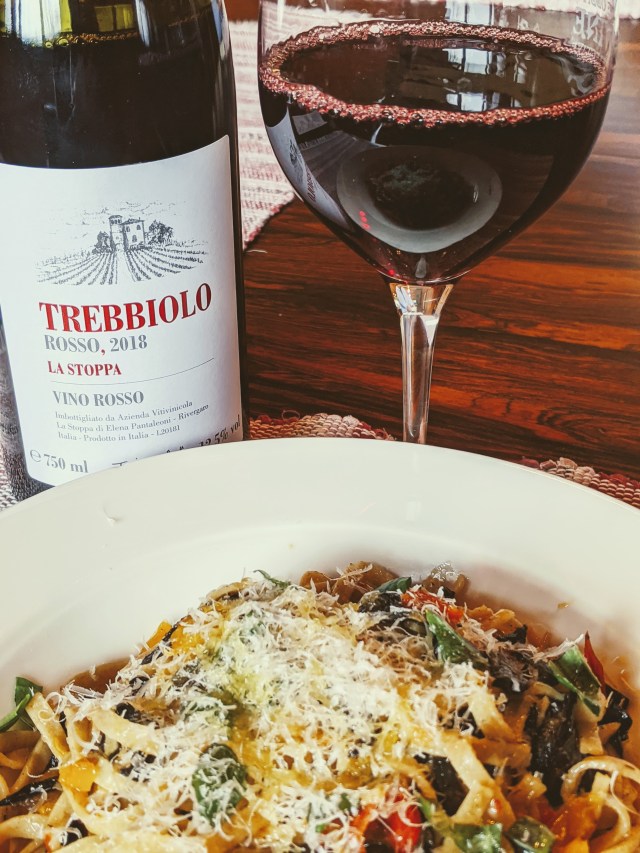
The finished dish was excellent.  It was delicious and brightly colored (off-white pasta and black mushrooms, with orange and red peppers, golden olive oil, and flecks of green basil), especially when paired with a 2018 Trebbiolo Rosso, La Stoppa, a robust Barbera/Bonarda blend from Emilia.  Tidbits do the job!

Posted in Almost-Vegan, Food, Vegetarian, Wine | Leave a comment

Lunches: Variations on Some Themes

Recent meals have gone so well that I’ve been motivated to continue some of the themes.  Three elements stood out:

  • grilled or pan-fried bread
  • peppers
  • sautéed greens

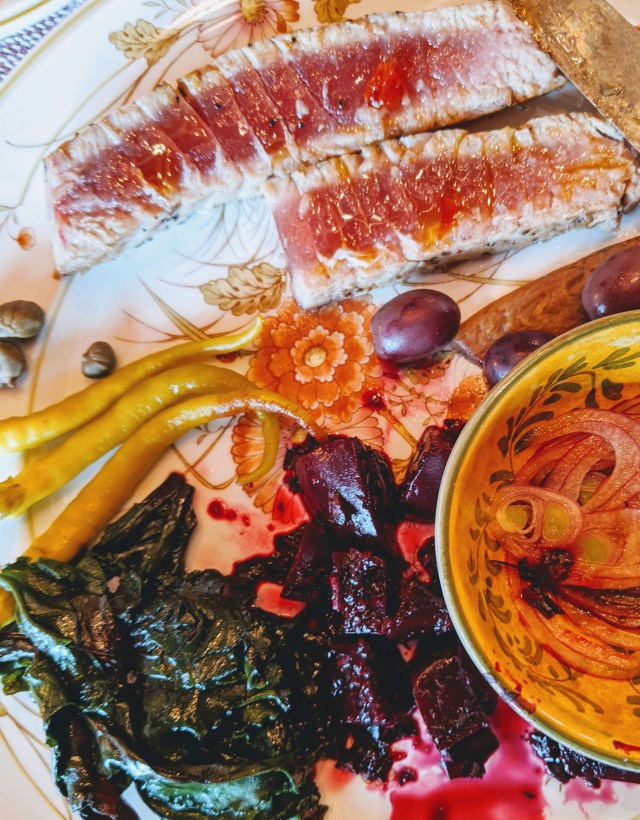
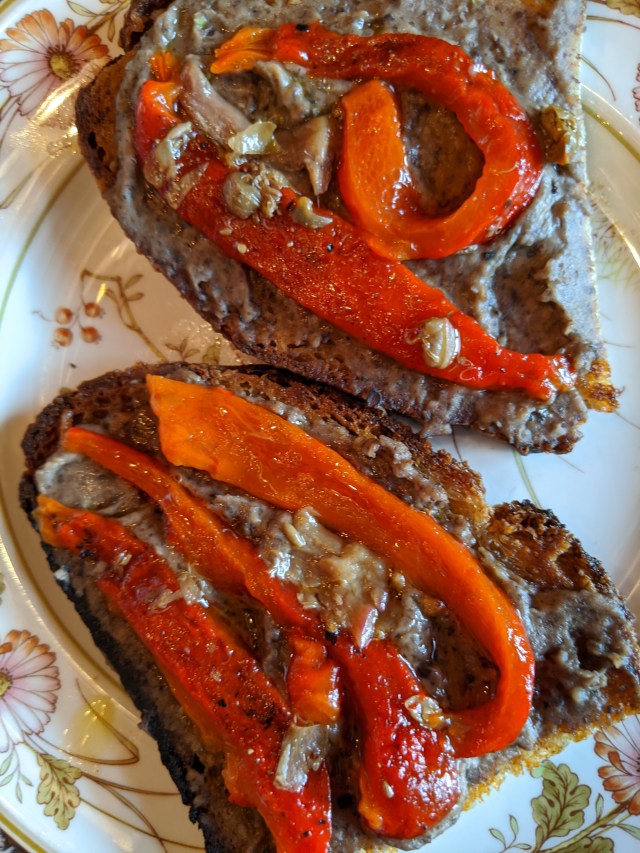
so I had several variations for lunches this week.  The first included a bit of the leftover tuna and associated pickled peppers and beets, plus bruschetta with heirloom Moro bean pureée, roasted peppers, and savory capers from Santorini.

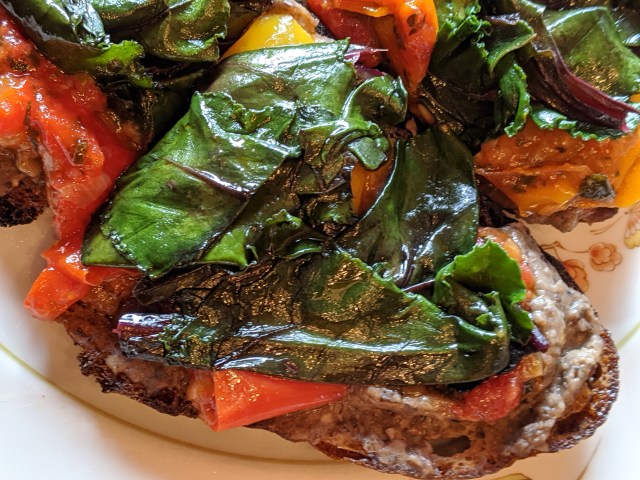
The next used the last two slices of the Field Blend #2 bread I baked earlier in the month.  They were first toasted with olive oil in a pan, then covered with bean pureée, and finally topped with the roasted peppers/tomato mixture and sautéed beet greens.

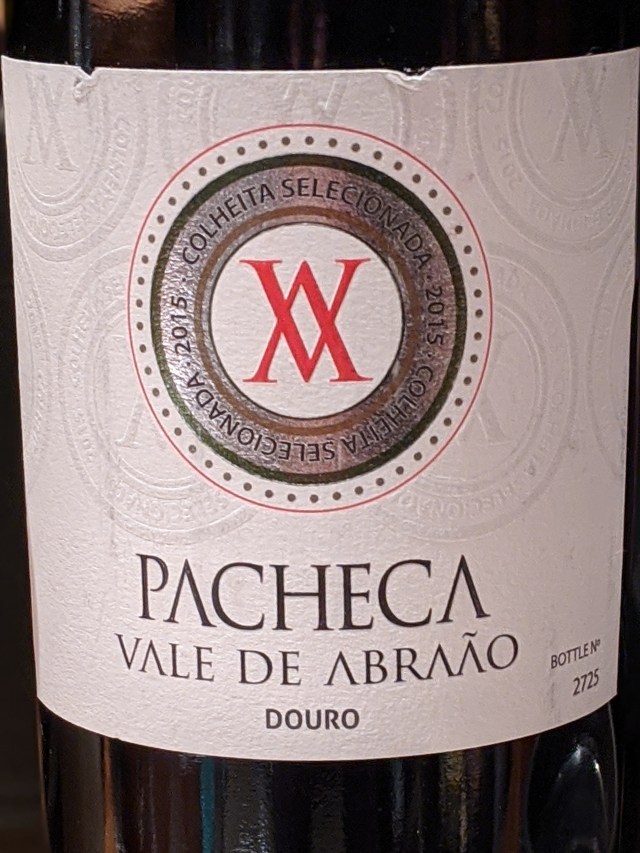
Naturally, wine was necessary to complete the picture.  I finished the rest of Aaron’s 2016 Chimera (Syrah/Mourvedre blend), and then I decided to introduce a new player — a bottle of 2015 Pacheca Vale de Abbrao from the Douro Valley in Portugal, purchased on our trip there last Spring.  The verdicts: very good, and even better!

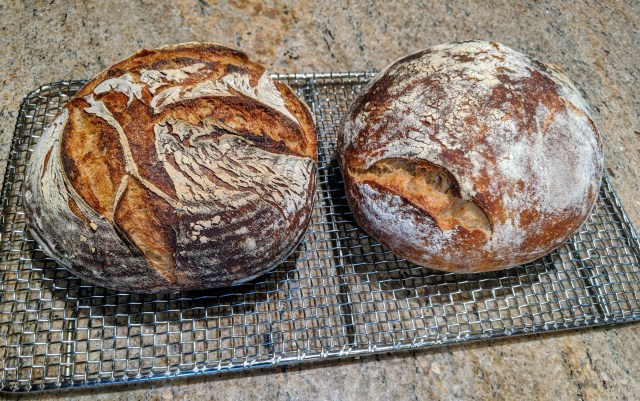
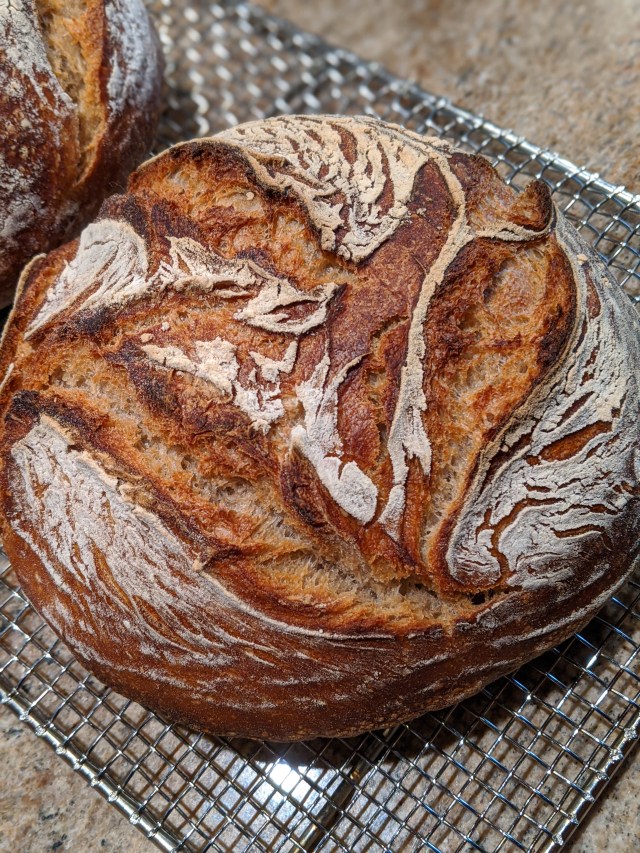
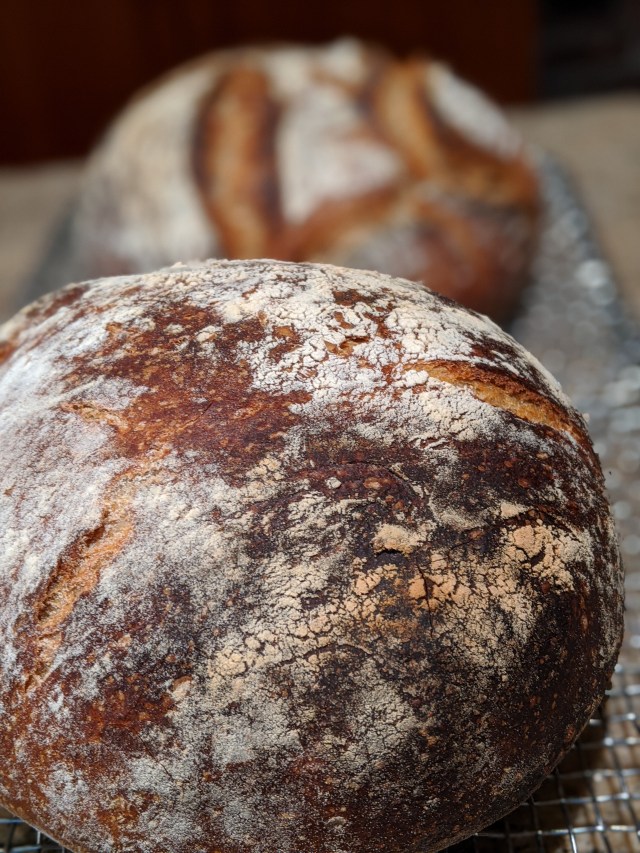
Next, it was time to bake bread again.  I hadn’t done two batches of bread in the same month for several years, but the need was there, and I had the time and motivation.  Sticking to the same Field Blend #2 formulation, I was able to deliver two more fine loaves.  I predict you’ll see more bruschetta soon.

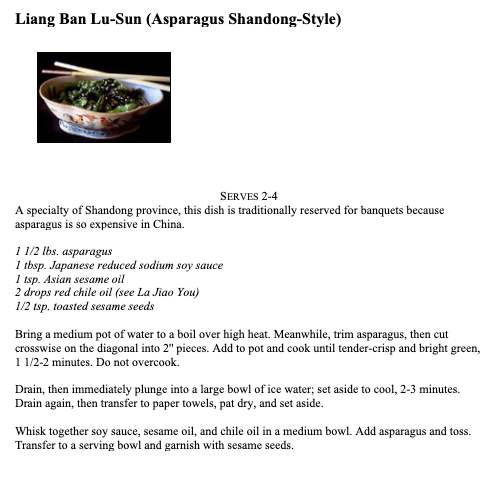
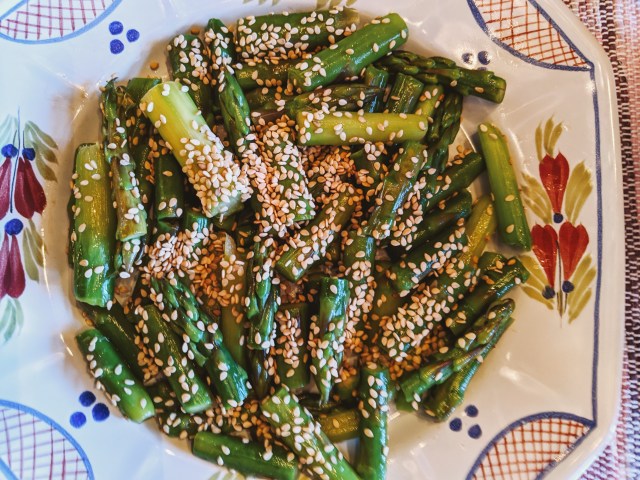
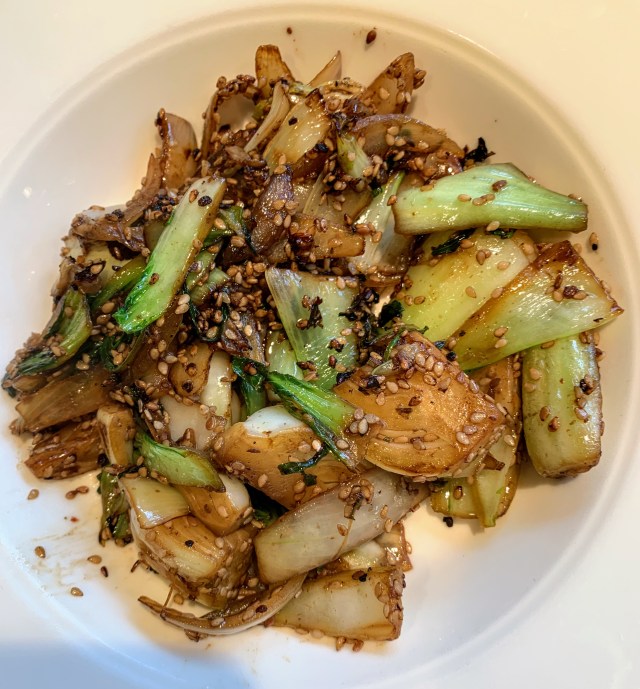
The most recent lunch was today’s.  It played on another recent theme, i.e. Bok Choy and Asian cooking.  I made two small dishes: (1) Asparagus Shandong-Style and (2) Baby Bok Choy Stir-Fry with Onion, Orange Pepper, Daikon Radish, and Sesame Seeds.

It was a nice warm afternoon, so we went for a walk after lunch.  Therefore, no wine at that meal.  The exercise was most welcome.

Posted in Almost-Vegan, Food, Vegan, Vegetarian, Wine | Leave a comment

Grilled Tuna and Roasted Italian Vegetables

Tonight was my kind of dinner.  Gusty flavors, lots of vegetables, and rich, red wines.

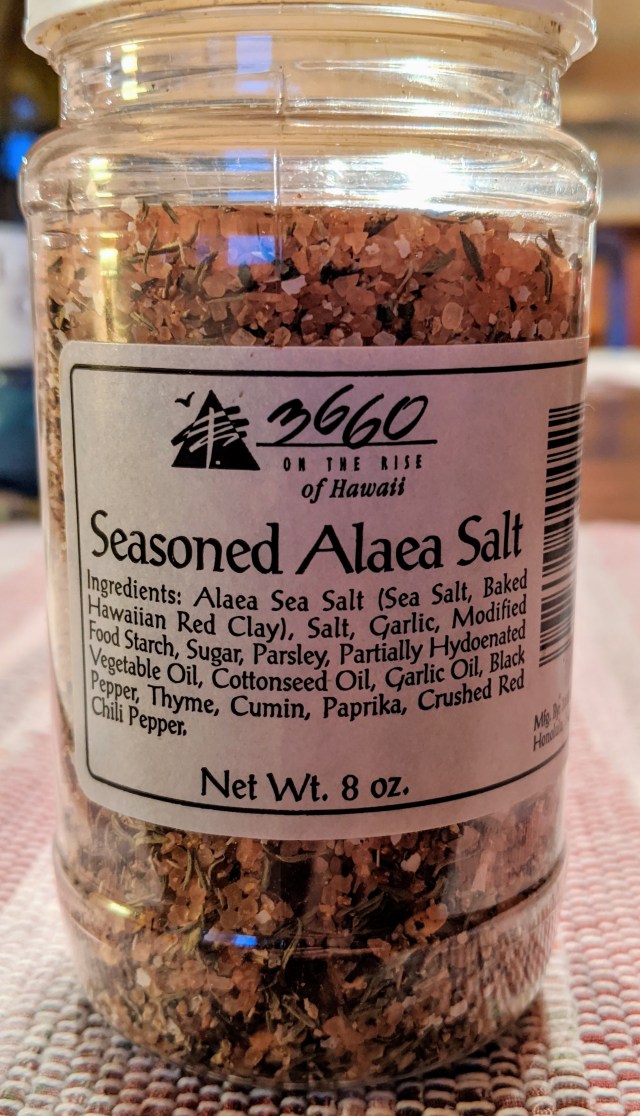
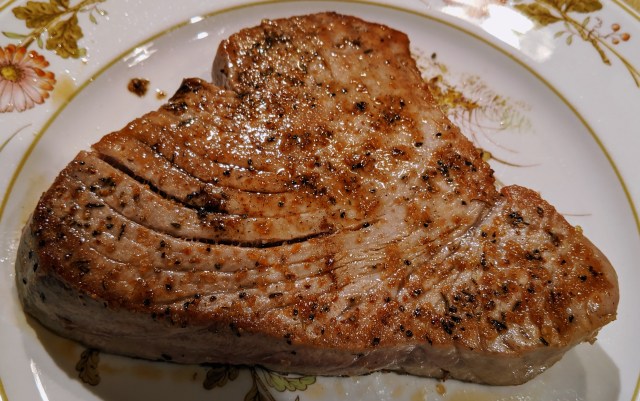
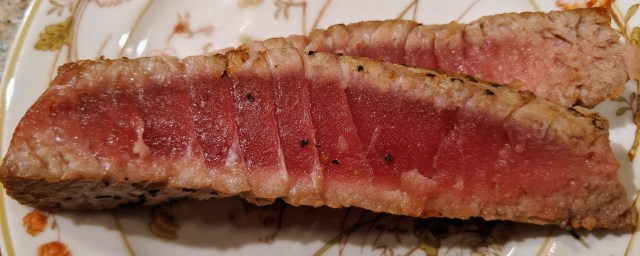
The main event was a lovely steak of sushi-grade tuna, from Idylwilde, our local greengrocer and much more.  This was done very simply, sprinkled with olive oil and Hawaiian Alaea Sea Salt (thank you, Hank!), and seared in a very hot cast iron skillet.

This was paired with a sautéed/braised artichoke heart, cooked in olive oil, wild Greek thyme, and finished with a little butter (sorry, no photo).

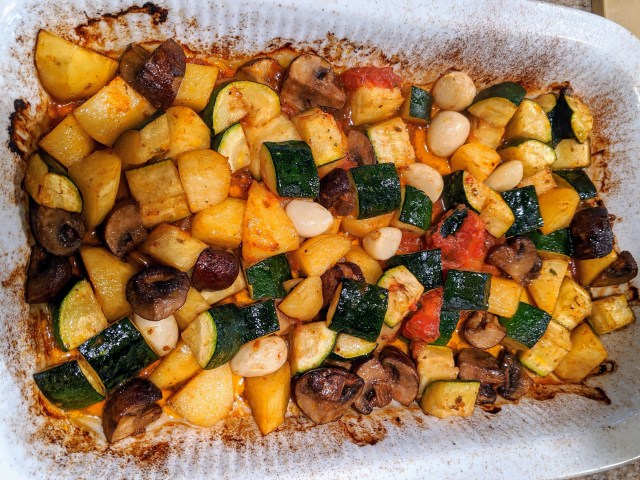
The main accompaniment was a dish of oven-roasted Italian vegetables, compliments of a new (to me) blog, The Mediterranean Dish, and her recipe.

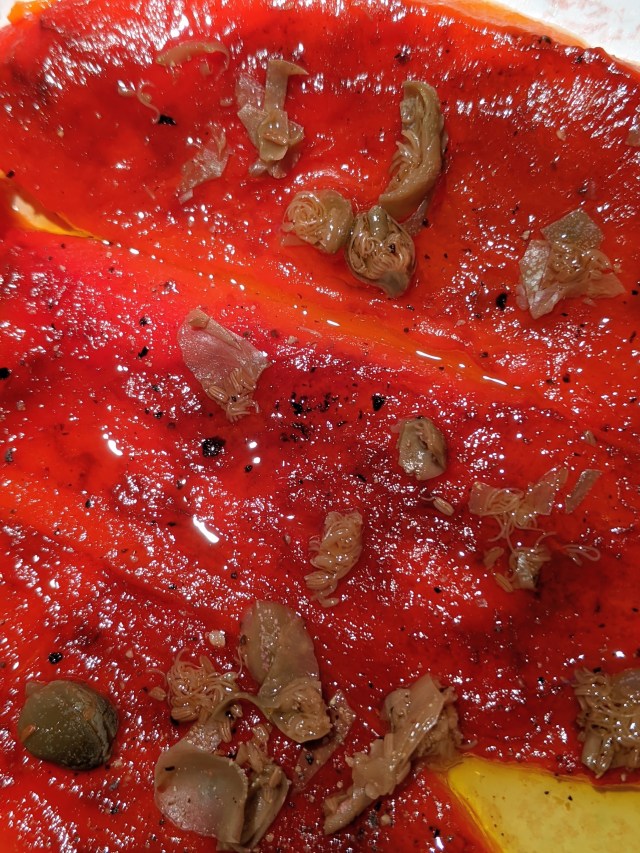
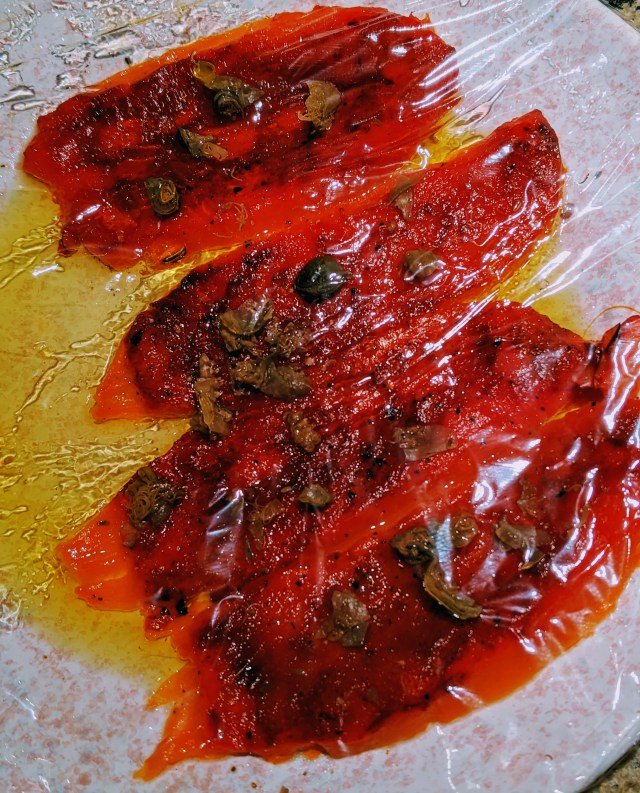
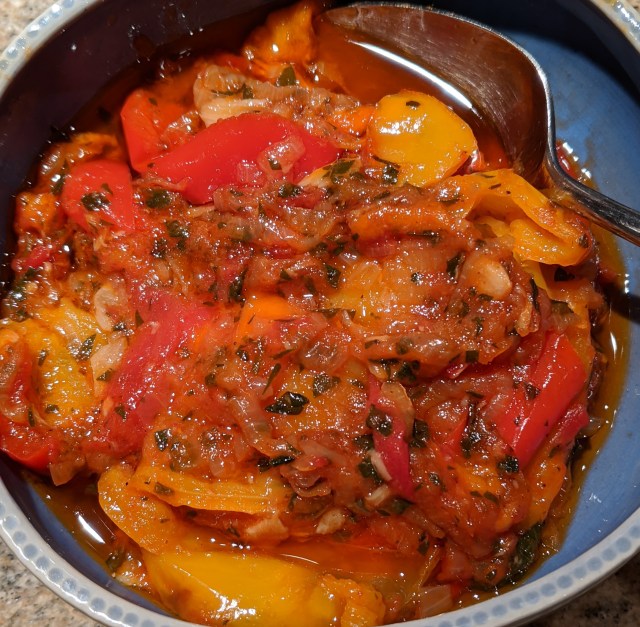
As side dishes just for me (Barbara does not eat peppers), I roasted on the gas grill and peeled one pepper, and I cooked three other colorful bell peppers in a sauté, Puglia-style, with onions, garlic, a little tomato, and chopped parsley.  The roasted pepper was topped with Santorini capers and olive oil.  Now, I am set with Bruschetta toppings for several days ahead.

Which leaves only the wine to discuss.  Last night I had opened a bottle of Aaron’s 2016 Chimera, a blend of 1/3 Mourvedre and 2/3 Syrah from two different AZ vineyards.  It was very good last night with the chicken and kugel Barbara made, and the remainder was perfect tonight with the tuna and roasted veggies.  For my second glass, I opened a bottle of 2013 Linne Calodo Martyr, a blend of Mourvedre, Syrah, Tannat, and Cinsault, from Paso Robles in California’s Central Coast region.  This was very good, too, but the Chimera was an even better match.

Posted in Food, Wine | Leave a comment

The Joys of Bok Choy

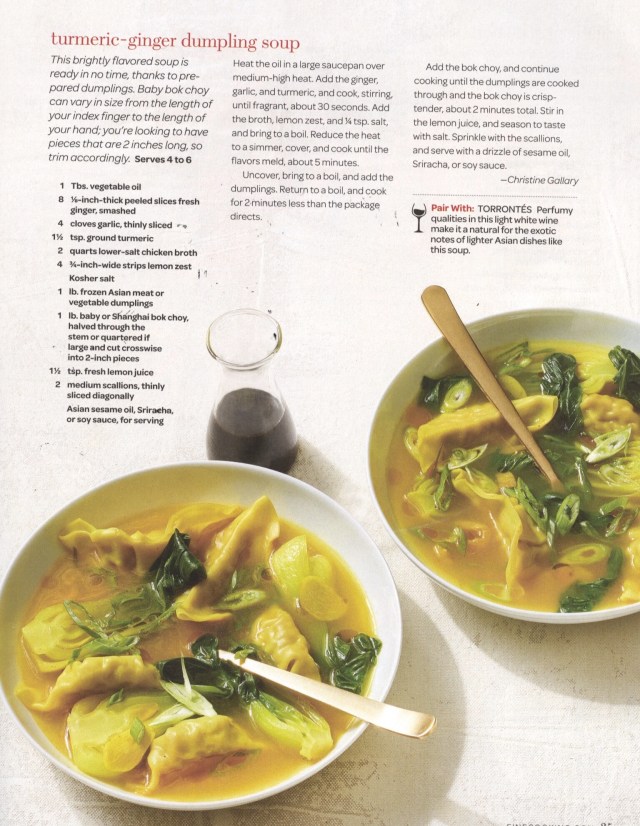
Barbara got me started on this kick a few weeks ago.  She had made a Turmeric-Ginger Dumpling Soup recipe from Fine Cooking Magazine.  It featured Bok Choy and is made with frozen vegetable dumplings (ours are from Trader Joe’s).  The dish was easy, delicious and quick, and it was just as good or better as leftovers the second day.

A few days later she invented an Asian-style vegetarian dish with some farm-fresh vegetables we had, using a perfectly-poached egg for protein and a sauce made with hoisin, shoyu, ginger, and black vinegar for depth of flavor.  It was terrific.

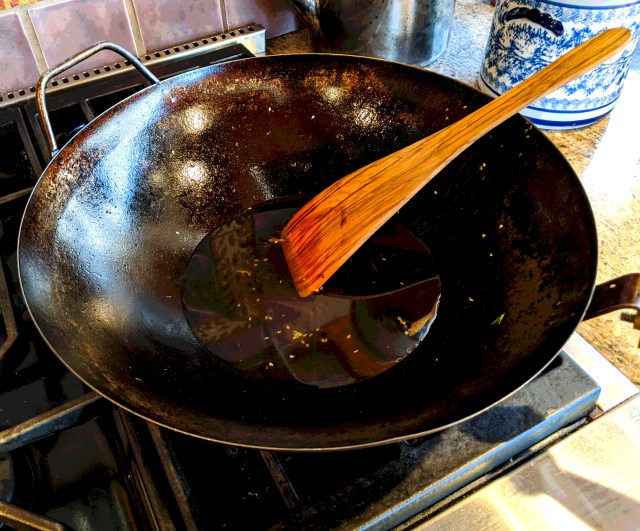
Now that I have more experience cooking bok choy, I was inspired to try some dishes of my own.  It also gave me a few opportunities to use a pot I adore — a wok bought in San Francisco’s Chinatown district over 40 years ago.  Over the years it has become as nonstick as anything Barbara uses, but it heats VERY quickly and sears better than any coated pan.
On different days I made two variations — each with onions and bok choy, sesame seeds and that Asian sauce combo (above).  One time I included sliced mushrooms (Shiitake and Cremini) plus chopped scallions.  Both were enjoyable.

Some brief notes on technique:

  • I like to cut an onion vertically (in 6 or 8 sections, depending on its size) for cooking in a hot wok, especially when making a dish with vertically-oriented bok choy
  • I also cut the bok choy vertically into 4 pieces (6 when it is larger).  Then I cut off the tops and separate them, so they go in last, because they cook quicker than the thicker base and rib parts.
  • Good safflower or peanut oil is essential; olive oil is also an option.  Don’t be skimpy; the oil is critical to caramelization and for even cooking.
  • If adding mushrooms, slice and cook those first, then remove from wok and add back in later to the whole dish.
  • Cook in stages.  First, the onion segments until browned some, then add the bok choy.
  • Add sesame seeds and stir-fry a little.
  • Now add the mushrooms, scallions or other ingredients.
  • Finally, add the sauce and stir until all is well-coated.
  • Can be served with or without, rice or noodles, and if noodles, then flour or beans

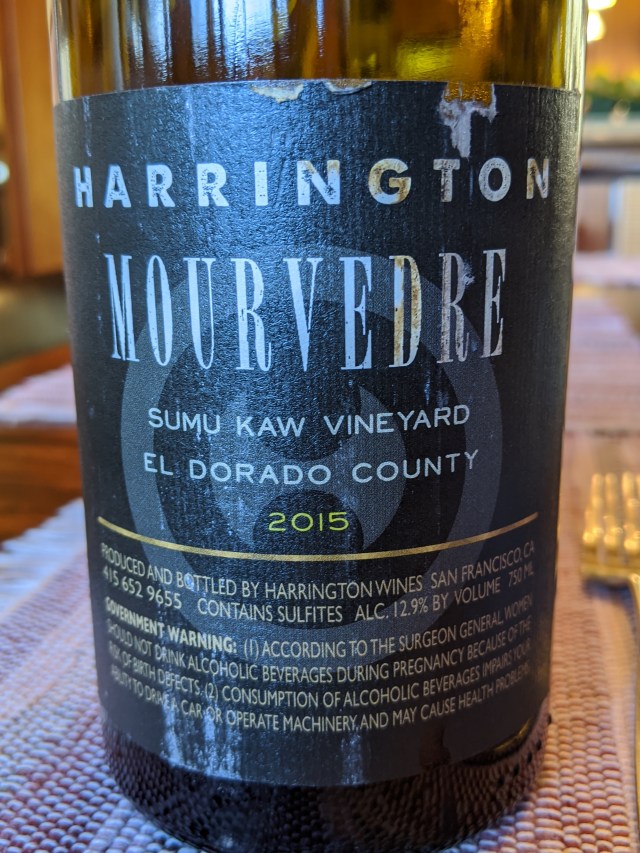
The sauce is rich in flavor, so I love a good red wine with these dishes.  For the version that had the mushrooms, I chose a California wine from Bryan Harrington of Harrington Wines, a 2015 Mourvedre.  It was spectacularly good.  In fact, so good, I was inspired to call Bryan and thank him.  When I looked up the number, I was very sad to learn that they closed up the business late last year.  A real loss.  Very good wines, made by a thoughtful, creative, and helpful entrepreneur.  Good luck with your next ventures, Bryan!


Posted in Almost-Vegan, Vegan, Vegetarian, Wine | 2 Comments

Tuna Conserva

A few weeks ago I went out for lunch (probably for the last time in several months).  Aquitaine Chestnut Hill was conveniently located, and I had not been to a local bistro in some time.  I chose a Salade Niçoise, mostly because I was interested in the “Tuna Conserva” mentioned on the menu.  It was very good, so when I found a lovely small tuna steak at Legal Sea Foods, near the restaurant that afternoon, I bought the tuna.  The next day I started researching “Tuna Conserva” on the internet.  I had poached tuna in olive oil before, but what I found was even less complicated and time-consuming:

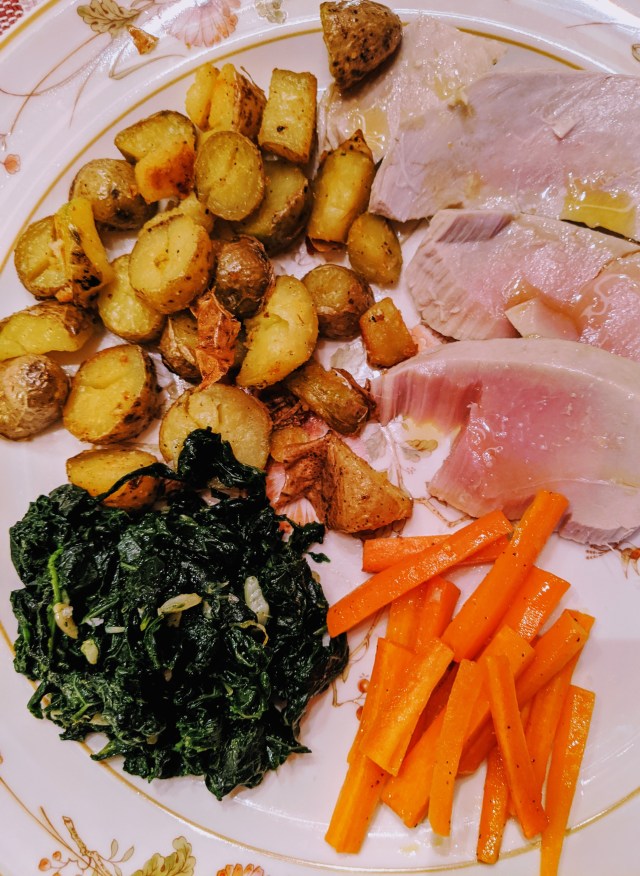
That night I made it for dinner, along with crispy sautéed fingerling potatoes, spinach with garlic, and sautéed carrots.  Delicious, and we had a little left over for lunch the next day.

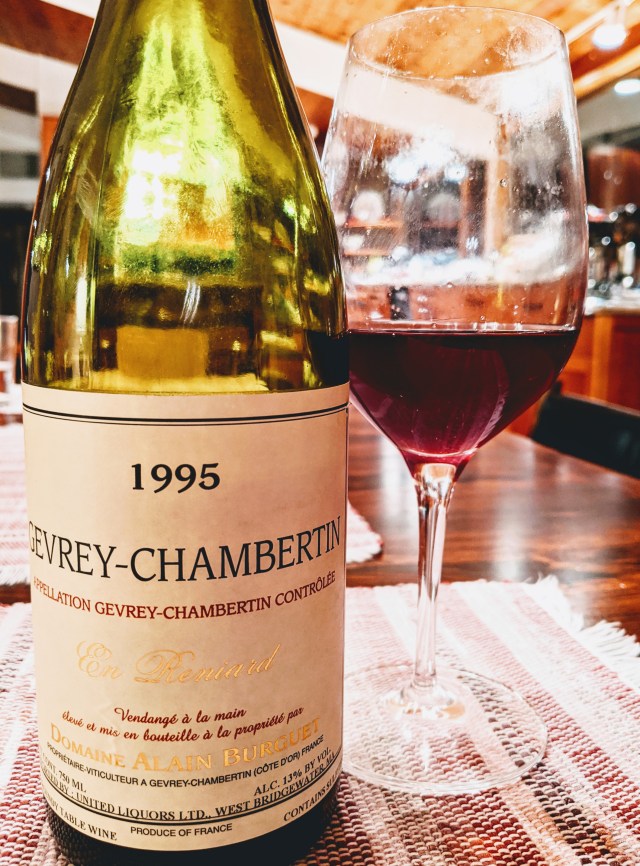
Realizing that the world might end later this year, I figured it was time to open a 1995 Gevrey-Chambertin from Alain Burguet that had been resting comfortably in my cellar for over 20 years.  That was my best decision all week.

Posted in Food, Wine | 4 Comments

More Bruschetta

My Field Blend #2 bread was so good, I defrosted the second loaf already and used it for all kinds of toast and bruschetta.  Here are the two most recent:

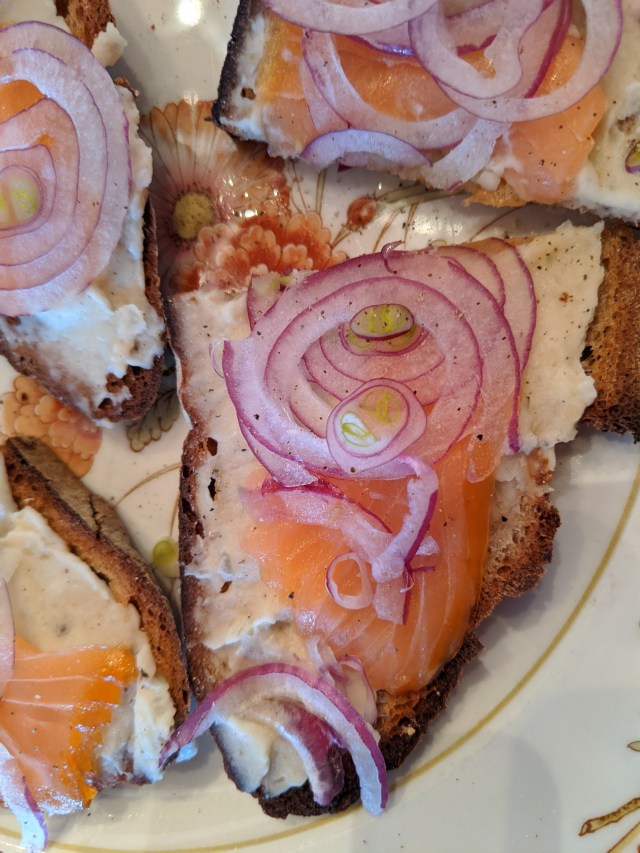
Smoked Salmon and White Bean Purée

  • Grilled whole wheat bread
  • Cannellini beans, soaked overnight,  simmered until tender the next day, sautéed in olive oil with chopped onion and garlic, and then pureéd with a little bean water and olive oil
  • Smoked Salmon from Whole Foods
  • small red onion sliced very thinly with a mandoline

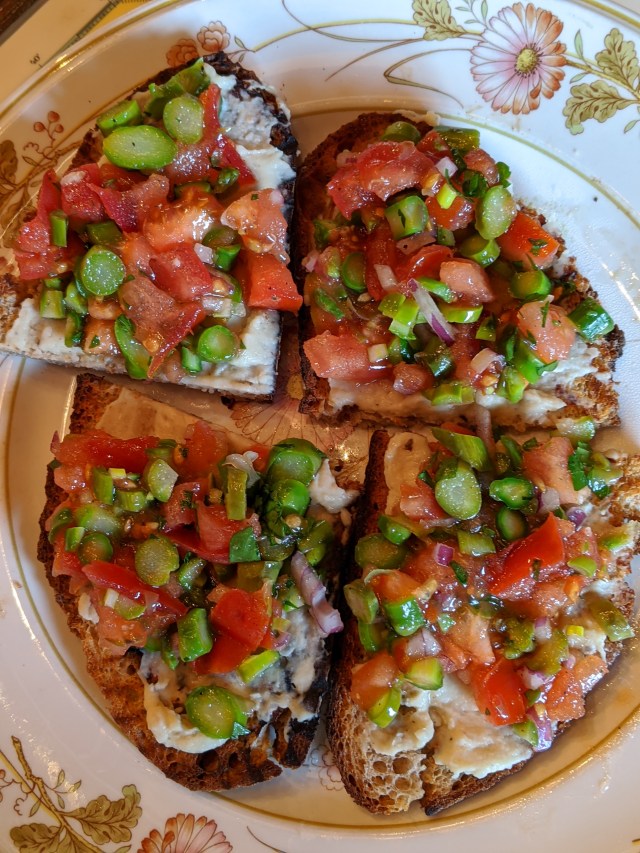
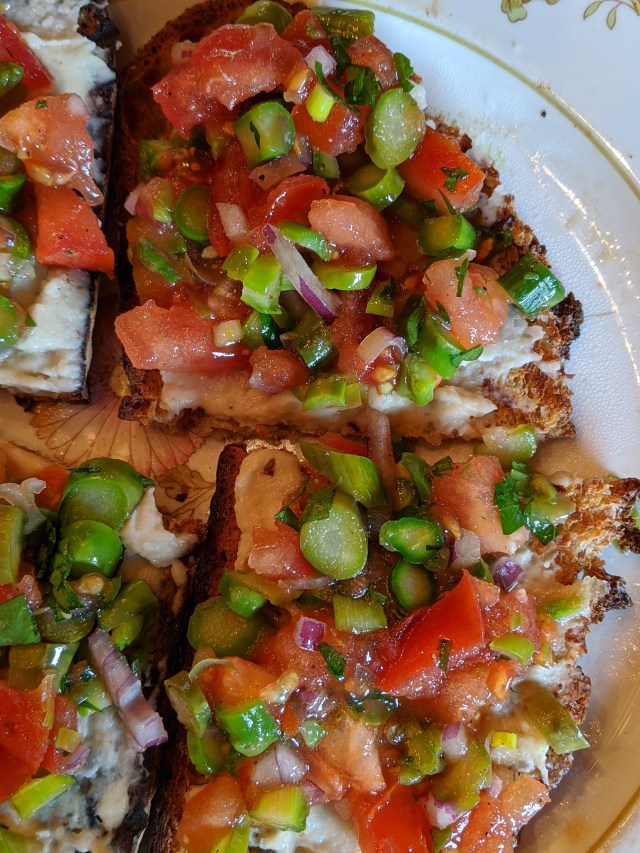
Chopped Asparagus and Fresh Tomato with Bean Purée

  • Same white bean purée
  • Small asparagus spears, simmered until tender, then chopped finely
  • Fresh tomato, finely-diced
  • Chopped shallot
  • salt and pepper
  • all atop grilled Field Blend #2 sliced bread

Serve with almost any dry white wine.


Posted in Food, Vegan, Vegetarian, Wine | Leave a comment

Spring Fling

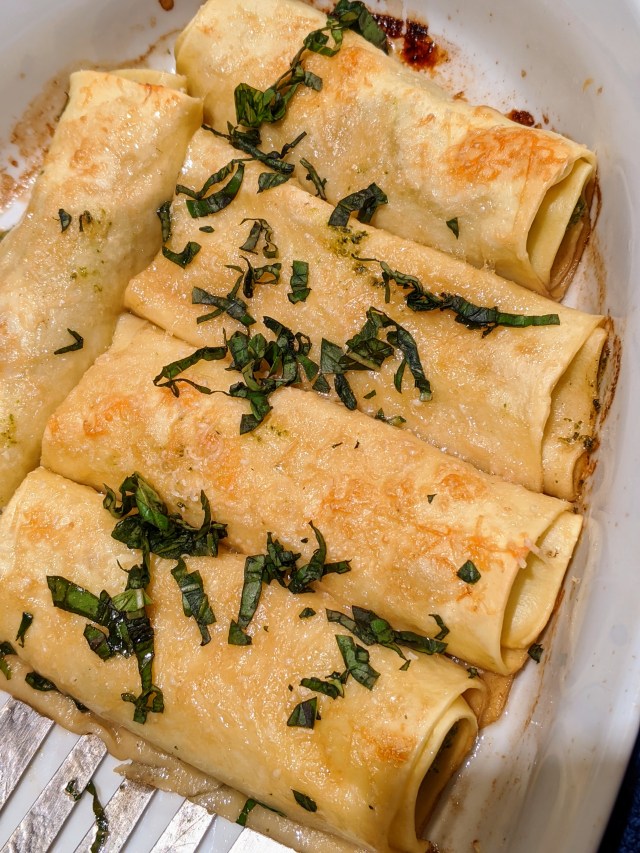
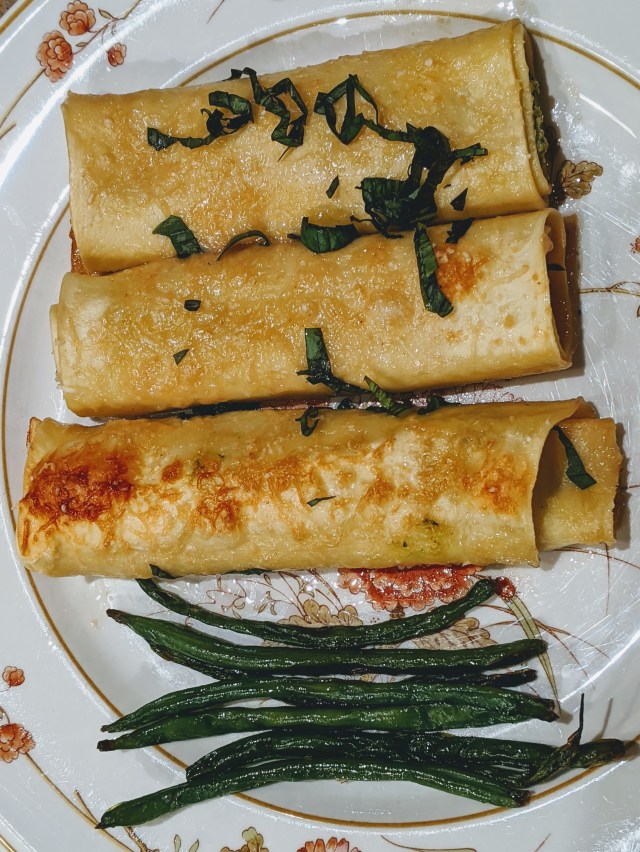
I love when I have time alone to experiment in the kitchen.  Yesterday, I made dinner — Baked Cannelloni with Spinach/Swiss Chard/Almond Milk Ricotta Cheese Filling.  With just 190 grams of double-zero flour and two eggs, I was able to have 11 sheets of pasta (each about 4″ x 6″) to turn into Cannelloni (similar to an earlier post).  Served with reheated green beans, it was a delicious meal for the two of us.

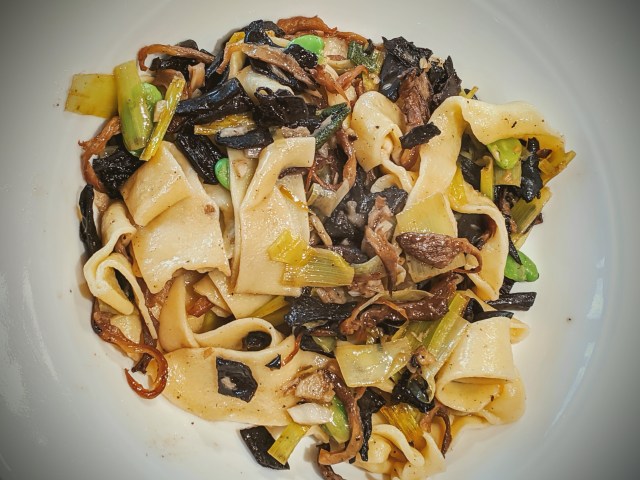
In addition, the process of cutting the pasta sheets to size left me with some odd-shaped trimmings for later use.  Roughly approximating wide noodles, they were a perfect palette for the wild mushrooms I needed to use today — black trumpets and oyster mushrooms.

I did a little research on the Web to brush up on cooking black trumpets.  Minimalist and easy is the answer.  I started by chopping a small leek and mincing a garlic clove.  These were sautéed in 2 Tbs. of sweet butter and 1 Tbs. olive oil, along with a few small fresh sage leaves.  After setting a pot full of water to boil for the pasta, I shelled two pods of fresh Fave Beans, dropped them in the hot, salted water for 2 minutes, and peeled them before setting them aside.  When the leeks and garlic were almost done, I added a glass of white wine to the pan and boiled it down.  Then I added the mushrooms — the black trumpets (fresh) and the thin strips of oyster mushrooms (already cooked earlier in the week).  These cooked with moderate heat in less than five minutes.

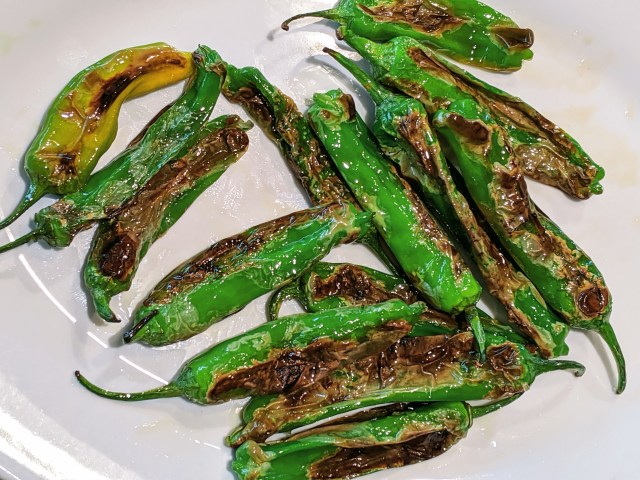
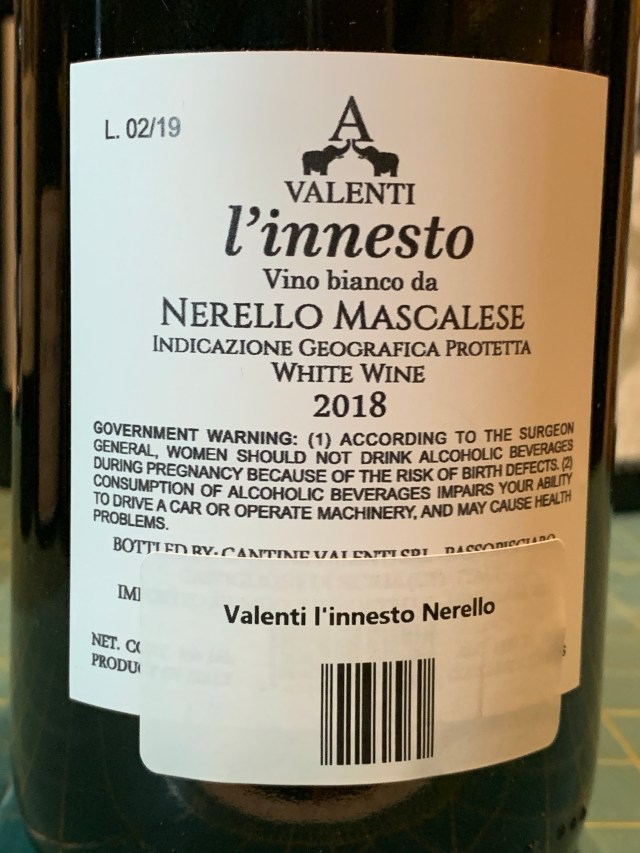
The final step was adding the Fave Beans, plus the boiled noodles and some of the pasta water, cooking it long enough to finish the noodles and leave a sauce.  All served in a pasta bowl and accompanied by grilled Shishito Peppers and a glass of Nerello Mascalese Bianco by Valenti, one of Nick Mucci’s growers in Sicily.  Perfetto!

Posted in Almost-Vegan, Food, Vegetarian, Wine | Leave a comment

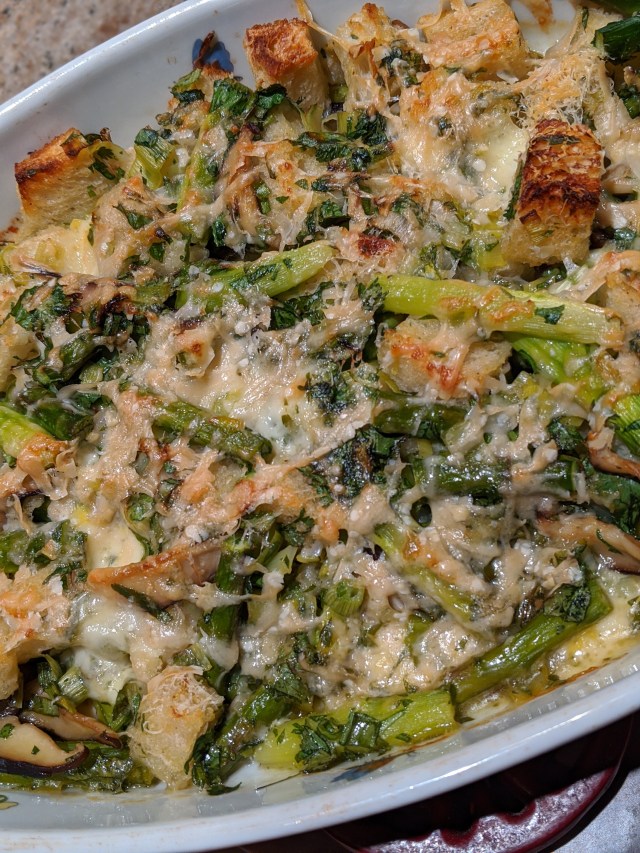
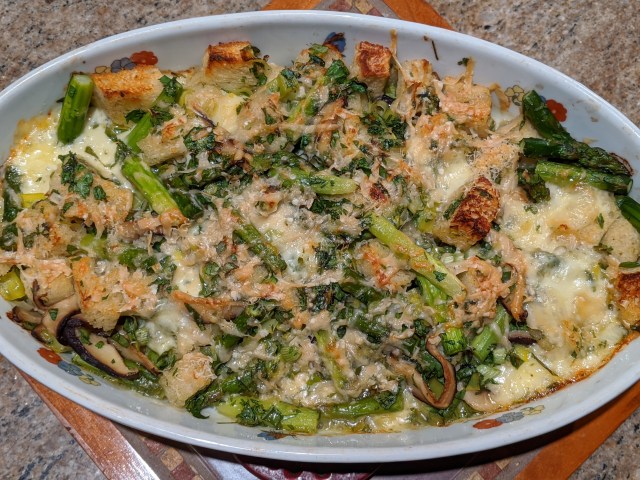
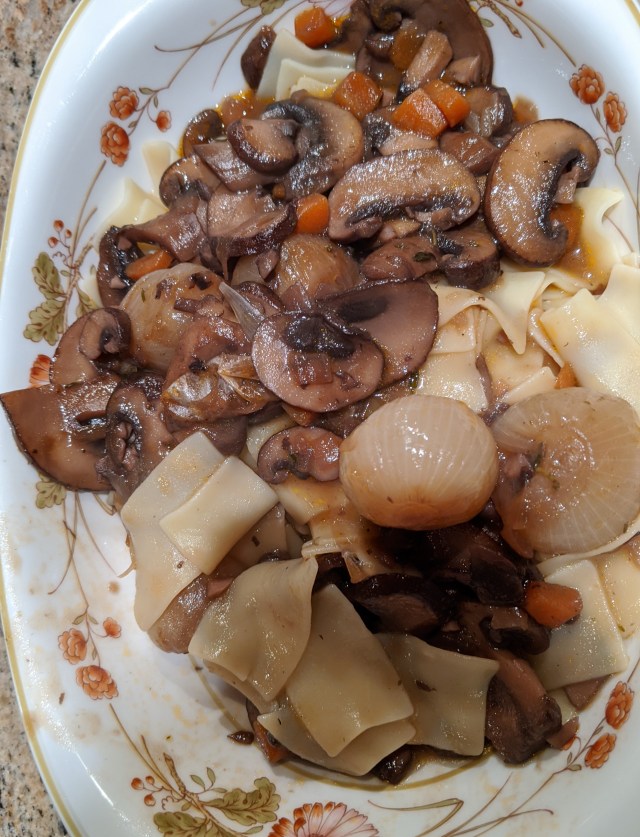
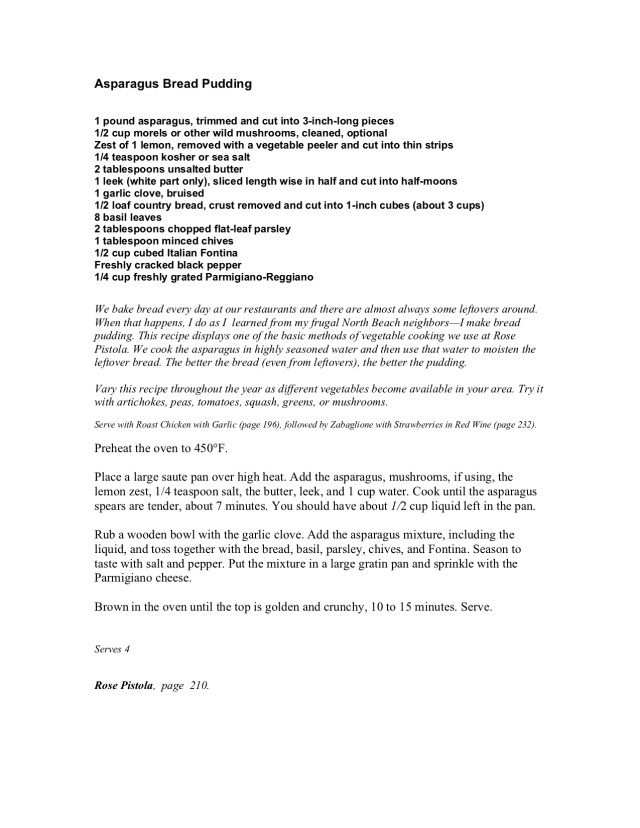
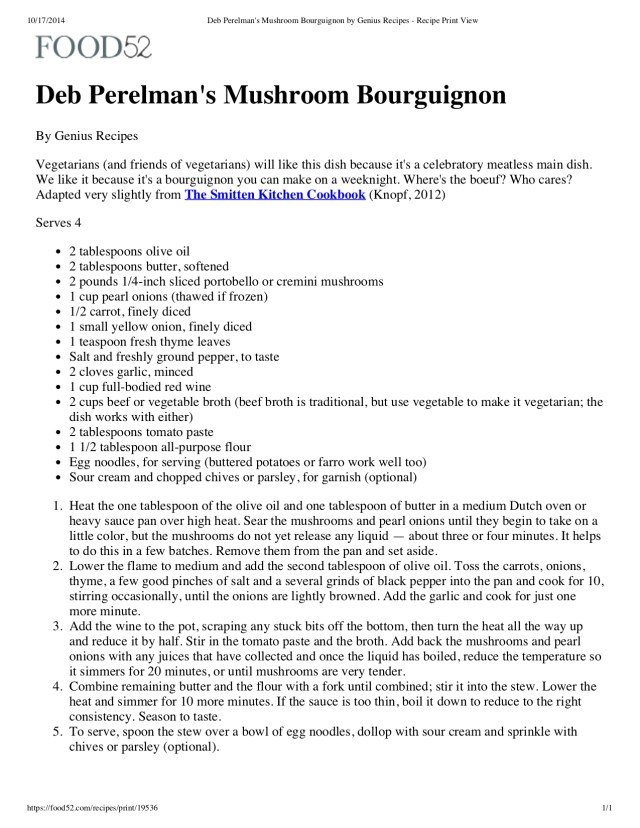
Asparagus Bread Pudding and Mushroom Bourguignon

With mushrooms at the markets providing the impetus, I pulled out two old but charming vegetarian recipes from our archives, and we enjoyed them for dinner and subsequent lunches.  Originally, I planned to make them the same night and serve one for dinner the next evening.  However, they both looked and smelled so good, we had some of each.

Posted in Almost-Vegan, Food, Vegetarian | Leave a comment