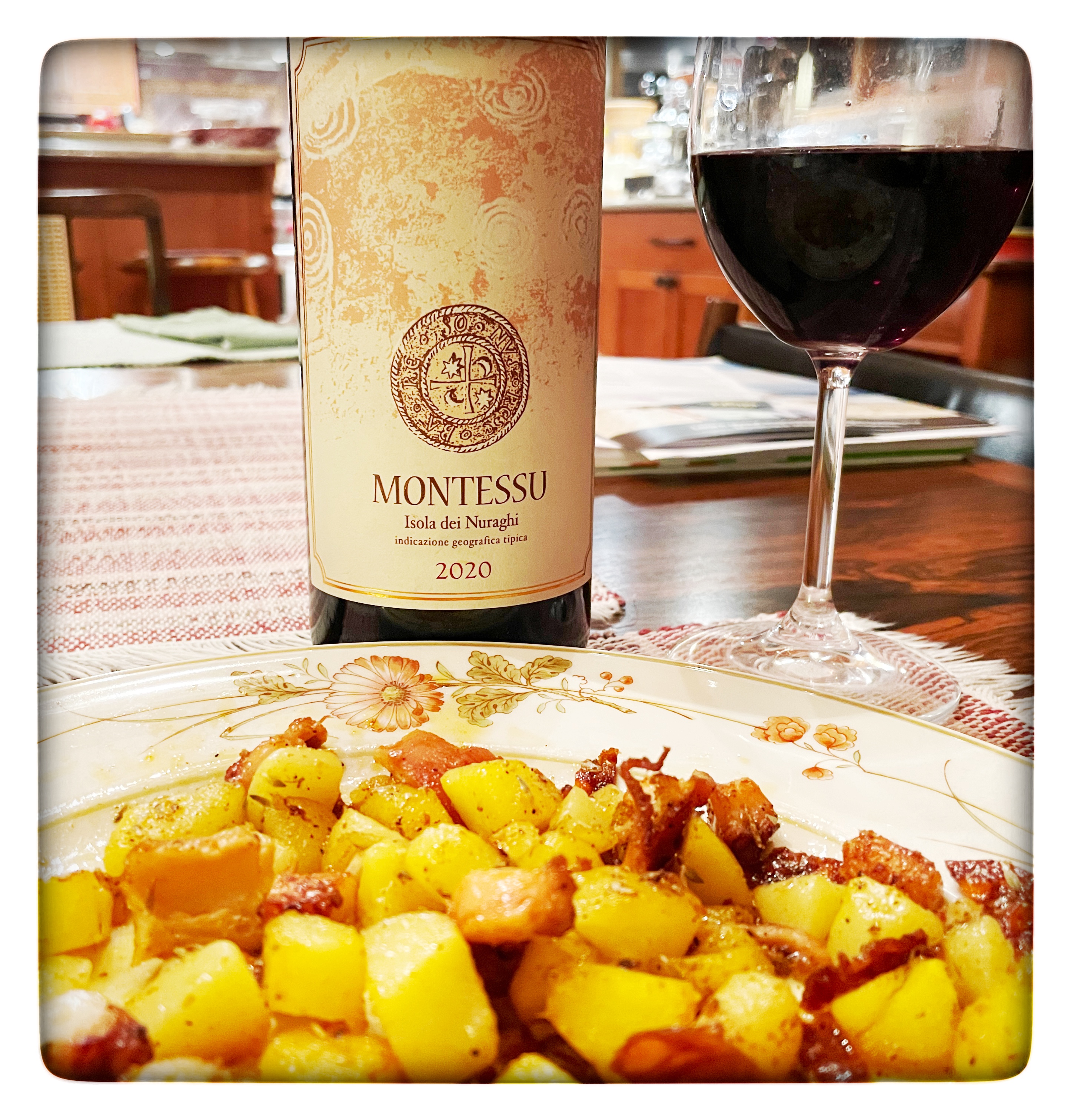
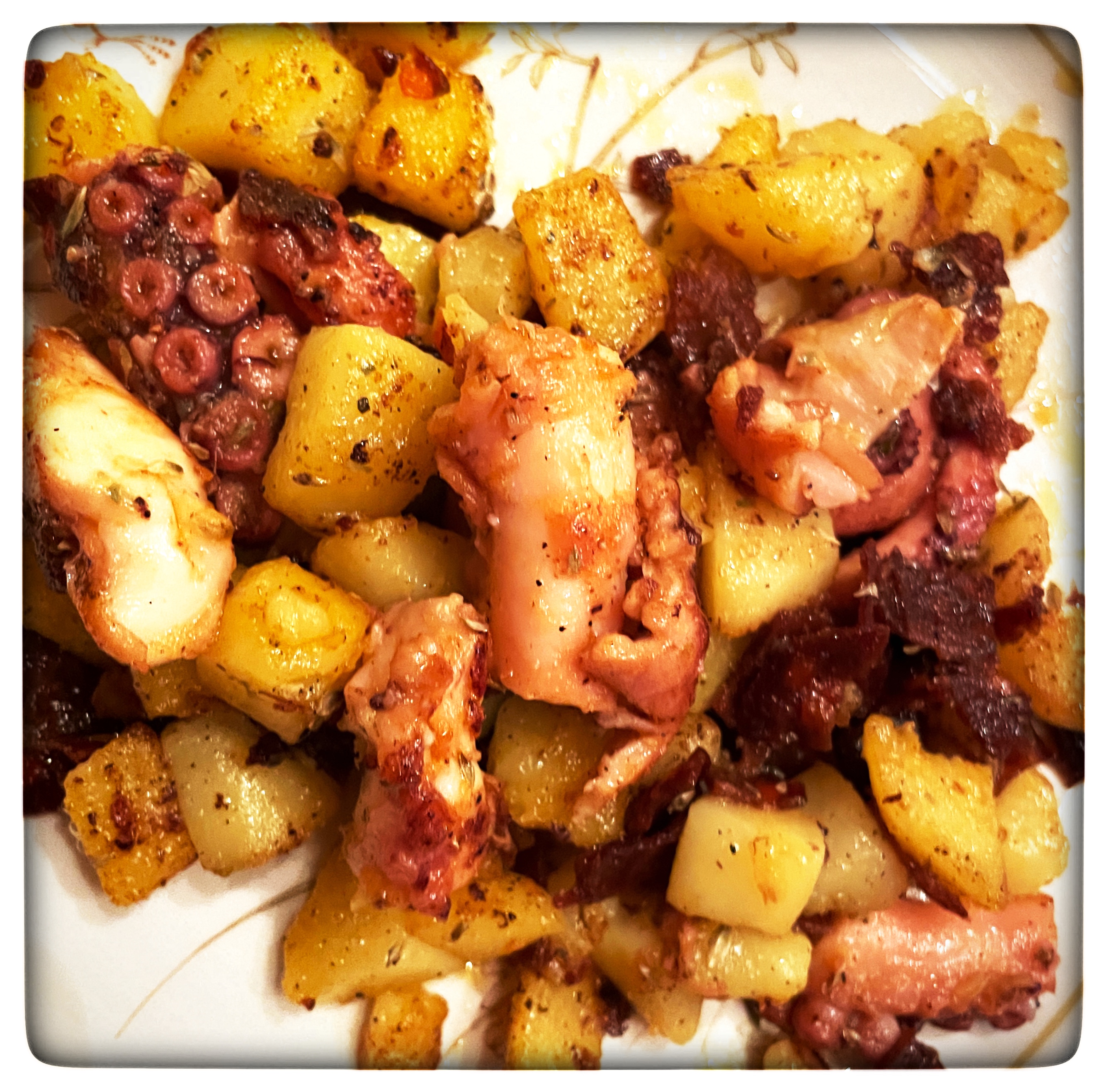
I think I’ve just found my new favorite octopus dish for dinner. It is octopus with chorizo and potatoes, a Spanish style dish that has all of the ingredients I needed on hand. The recipe is very straightforward, and it took only about 20 minutes to put it all together, once I had prepared the octopus in my usual fashion.
An essential ingredient was Spanish chorizo. Mine was thinly cut vs. cubed, but that was close enough for government work.
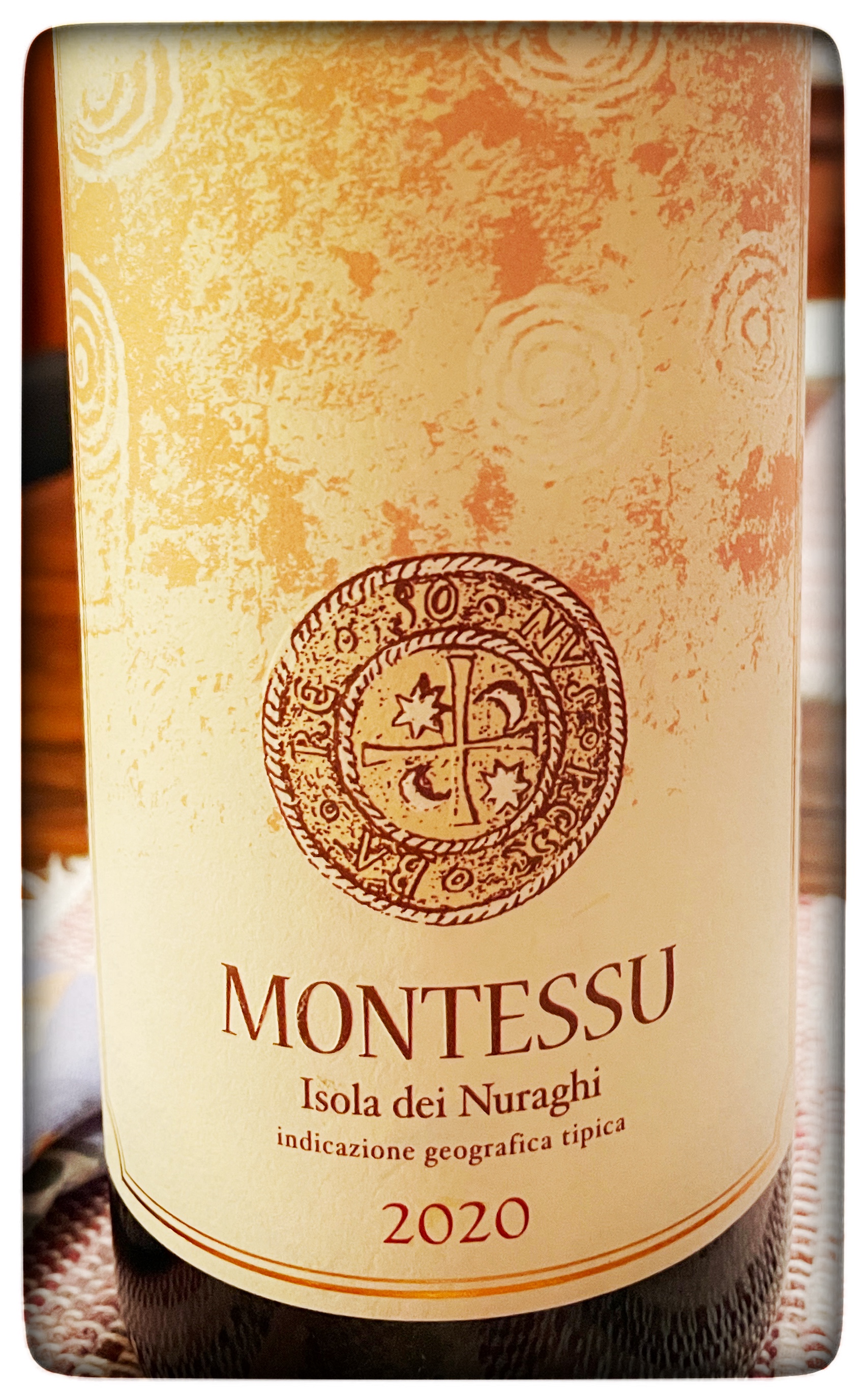
What made the meal fabulous was a Sardinian red wine — Montessu, a blend of mostly Carignano grapes, blended with some Syrah, Merlot, Cabernet Sauvignon, and Cabernet Franc. This was a recent purchase from Winestone in Brookline, and it was a perfect match for this dish.
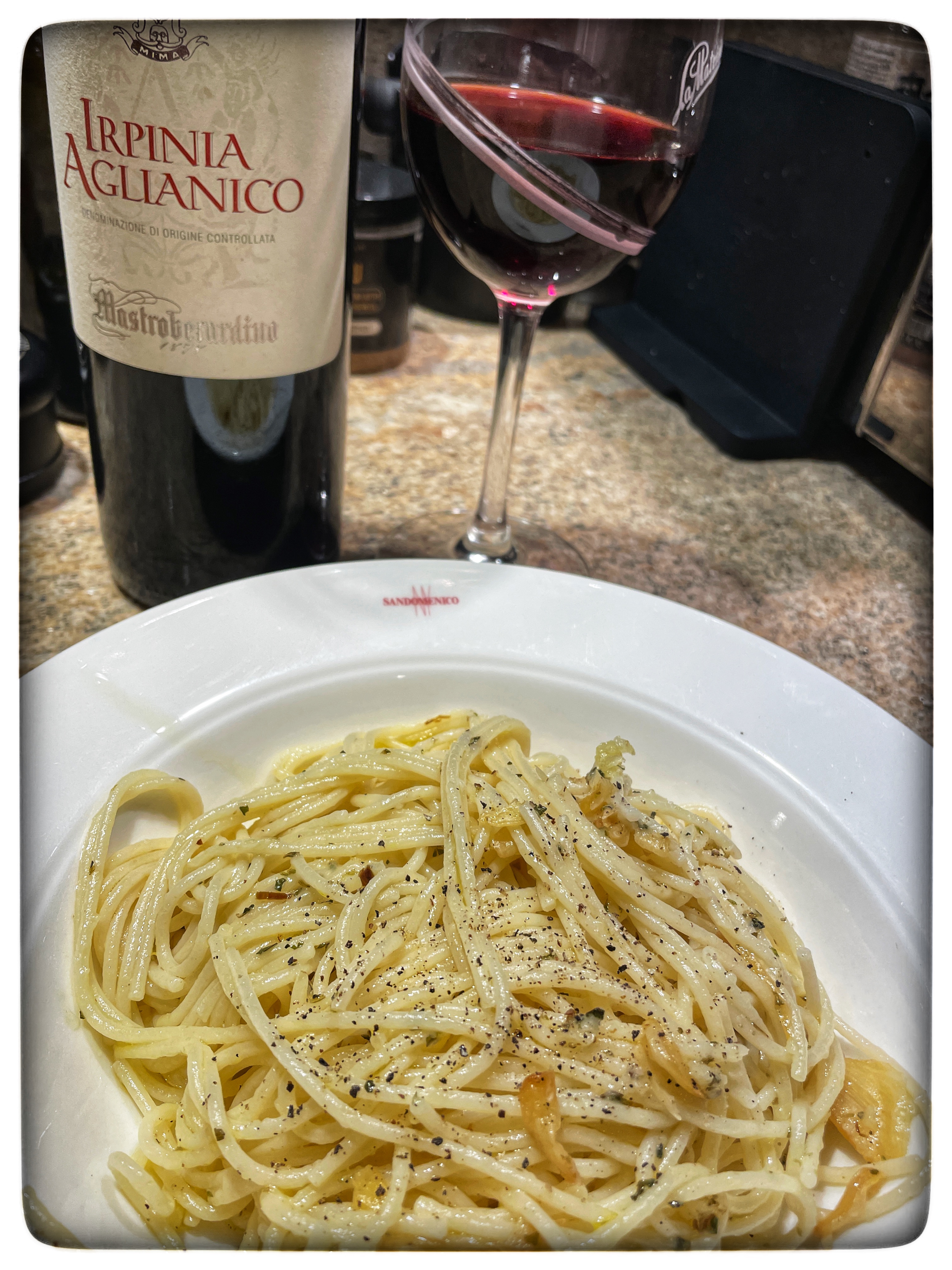
The Calabrian chili peppers, fresh ground black pepper, and a pile of dried Italian oregano provided the desired zestiness. The spaghettini cooked quickly, and it was just a bit thinner than spaghetti, so it was perfect for this combination of ingredients.
A glass of Mastroberardino’s Irpinia Aglianico from Campania is all that I needed to complete the meal. Sometimes “simple” is both easy and best.
Earlier this week I made a thoroughly French dinner, inspired by a bottle of wine from Winestone in Brookline, MA. It was a Cassis from Domaine du Bagnol, made from three grapes: Marsanne, Clairette, and Ugni Blanc.
Using salt cod recently purchased at Portugalia, I made a small dish of Brandade de Morue. The other delightful dish was Cauliflower with Mustard-Lemon Butter. The Brandade recipe and the Cassis wine both originated from the region near Marseille, and they transported me immediately to the Mediterranean.
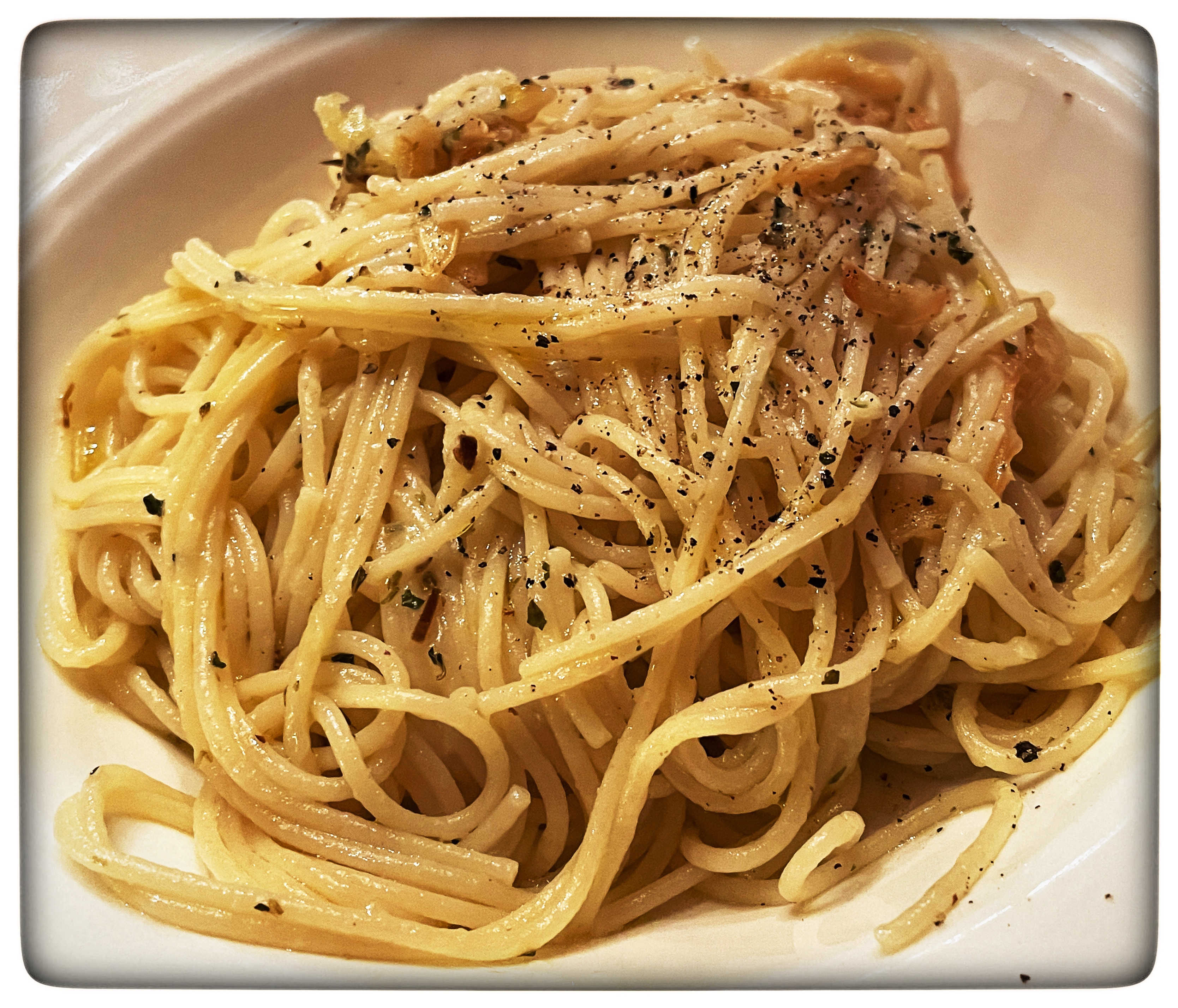
The next night was Italian: a simple meal of Spaghettini with Tomatoes and fresh herbs. I’m sure you can duplicate it if you wish, just using the photo below as your guide.
During the waning days of summer I often try to make some of my favorite dishes of this cheerful, bright season. Two beloved ingredients are frequently the stars of these meals: lobster and corn. Three years ago I created a risotto featuring them both.
Recently, I found good lobsters at very reasonable prices at Market Basket. I bought just one and decided to try a similar dish with cherry tomatoes and pasta instead of rice. What do you think?
This funky orange wine from Uruguay complemented the dish well — beyond my wildest dreams!
I now have a new favorite recipe for a sourdough rye bread. It’s made with these proportions:
40% white bread flour
30% spelt flour
15% rye flour
15% whole wheat flour
200 grams Levain
75% hydration and 1/4 cup caraway seeds, crushed with mortar and pestle
It makes a wicked good grilled cheese sandwich, and it’s perfect for breakfast — sautéed in olive oil and topped with peanut or almond butter and a bunch of sesame seeds.
Eggplants are one of my most treasured vegetables, so I cook them often in mid-summer.
My wife did some unusual explorations, and she came up with this Armenian dish made with bulgur.
Early August was a fine time to have dinner at La Bodega in Watertown. The chef had made a vermouth from rosé. It was a lovely starter for the meal.
The next course was a delicious beet salad smothered with sheep’s milk grated cheese, and a wild mushroom appetizer for accompaniment.
Of course, I never pass up the opportunity for grilled octopus, especially from the wood-fired oven.
Even the decorations in the bathroom were attractive!
While we are talking about eating out, I should share a small lunch at Select Oyster in Boston. A few very good oysters and and delicious yellow-fin tuna plate were quite satisfying.
For semi-retired folks like me, lunches are a beautiful thing. Normally, there are no time pressures, no deadlines for when one must produce the meal. They provide a splendid mechanism to exercise your creativity while using up leftovers which would otherwise go to waste. And they can be served with or without wine, as you wish on any given day.
Today’s solo lunch for me illustrates these principles. The meal was built around a series of small plates. The first one was a serving of fresh Padron Peppers, received yesterday from an online order with La Tienda.
Those of you who are regular readers know that I have no financial interests in any of the products I recommend in this blog. I just want my readers to be able to have access to the best ingredients, easily.
Simple dish: peppers, olive oil, sea salt flakes:
Next was a dish based on several leftovers in the fridge: two small calamari tubes, home-roasted and peeled sweet peppers, and sautéed pieces of mushrooms — Oyster and Lion’s Mane varieties. These were sautéed in the same pan as the padron peppers, so as to use the flavored olive oil and minimize dishes. A little Piment d’Esplette supplied a bit of spice to the meal. (You may notice the prevalence of peppers of all kinds in my lunches. That’s because my wife can’t eat peppers at all, so these are opportunities for me to go ‘hog wild’ without reproach.)
I still had plenty of mushrooms left, so the last dish was made with Ciabatta rolls from Trader Joe’s topped with mushrooms. One slice was just that, and the other was gussied up a bit with Manchego cheese on top of the mushrooms, lightly grilled.
As usual, good wine makes it all come together nicely. Today’s pick was new to me. It was a delightful surprise I learned a couple of days ago from a friend and former student (Marshall). He was a graduate of our Wine 101 Seminar seven years ago. He recommended Mbali from Trader Joe’s, a blend of 79% Chenin Blanc and 21% Viognier. This wine was outside my normal price range (retail price $4.97), but I took a gamble and bought 2 bottles yesterday. It was the perfect choice for this eclectic set of dishes. Thanks, Marshall!
Mid-July is a good time to do what I enjoy most — conceive, create, and consume great meals. It’s a time when fresh vegetables are in season and plentiful at local farm stands; it’s a period when I have the time to select and gather superb ingredients; and it’s a month when I have the time to devote to making homemade sourdough bread and homemade pastas. I’d like to share with you the highlights.
Bread
A month ago I had made one of the tastiest breads in my 14 years of bread baking. It was an 80/20 sourdough blend (80% white bread flour and 20% whole grain flours). This time I decided to make one small tweak to the ingredients, reducing the white bread flour by only 20 grams and replacing it with the equivalent amount of Type 85 flour. Thus, the final mix was 78/22:
780 g white bread four
100 g freshly-milled spelt flour
50 g freshly-milled rye flour
50 g freshly-milled sprouted red wheat flour
20 g Type 85 flour
Making sourdough begins the night before, when I add fresh flour and water to 50 grams of my bread starter to prepare the Levain. During the six hours the next day for developing the dough the next day, everything seemed to be going smoothly — until I got to the bread shaping steps.
The dough refused to hold together, with tears in the structure, causing minor panic. After 1/2 hour of bench rest for the two loaves, I followed instructions for remedial work, and I repeated the shaping and bench rest steps. I didn’t get restored confidence, but the loaves seemed to hold together well enough that I got them into their bannetons and into the refrigerator for 4.5 hours to proof slowly before baking. I made one boule and one batard. The loaves did not have the oven spring I had hoped for and the shapes were a little weird. Fortunately, when I cut a slice of the still-warm loaf and buttered it lightly, I was very happy with the taste and texture.
To celebrate I opened a 2017 bottle of Chinon, a delightful Loire Valley red wine of 100% Cabernet Franc. It was definitely up to the task.
A few days later I took a trip into Cambridge for fish and came home with two salmon fillets. My wife turned those into Gravlax three days later, and we had another excellent use for the sourdough.
Other Notable Meals
One other time-consuming dish was a repeat (see blog of 6/16/23) of homemade spinach tagliatelle. This involved taking a package of freshly-picked baby spinach (8 oz. including the stems, 6 oz. after the stems were removed), washing the leaves and puréeing them in a food processor. The process then is to mix a blend of pasta flours (“00”, Majorca, and Semolina) and one large egg plus salt until the dough is stiff enough to roll out for pasta. Normally I make a small batch with about 100 grams of flour or a big batch with 200 g and 2 eggs. To my amazement the spinach purée contained so much water that I needed about 400 g of the flour blend to make the pasta. The final dish included fresh leek and green beans, lemon zest and grated Pecorino cheese. All’s well that ends well.
One day recently I had to defrost a block of frozen squid. This led to a delicious discovery of a recipe for calamari with potatoes and Piment d’Esplette, accompanied by a Sardinian Vermentino.
A few leftover beets went supremely well with slice red onion, Feta cheese, and Balsamic Vinegar.
To feed us comfortably during the extremely hot and humid days this July, my wife mastered the art of making cold soups — Gazpacho, with watermelon and tomatoes.
It was a month of weather extremes, punctuated by exceptional seafood, successful homemade breads, and sparkling blue hydrangeas.
My wife pays a lot of attention to our hydrangeas. Most years the white ones are present in great profusion, but the bushes of blue ones produce very little. This year, however, the blue ones are outstanding. Why that happens is just another of nature’s mysteries.
Seafood is another matter. We have access to several sources of fresh, high-quality fish and seafood. The highlights included a 5-lb. Spanish octopus, a gorgeous piece of bluefin tuna, fillets of Atlantic halibut. My favorite dishes this time with the octopus were (1) grilled tentacles with sautéed fingerling potatoes and (2) octopus salad with celery, onions, daikon, and tomatoes.
What made the fingerling potatoes so good was that they were first braised with spring onion, shallots, garlic, and white wine. Then they were sautéed and crisped up for texture and flavor.
The block of tuna was about 3/4 lb., so we decided to make Tuna Carpaccio, as shown in one of my all-time favorite cookbooks, Venetian Taste.
One of the best, go-to recipes for an easy, delicious dinner is this one for halibut. It’s one of several in our repertoire for halibut, featuring mayonnaise and Dijon mustard.
I made breads twice in June. The first batch was a repeat of a Tartine-style multigrain loaf from a year ago: 80/20 with Rye and Spelt flours making the 20% whole grains.
The other bread choice was a Ken Forkish White Bread with Poolish, which I had made back in October, 2021. The Poolish is a pre-ferment made with 500 g. white bread flour, 500 g. water, and just a spec of instant yeast (0.4 g.). When mixed with the rest of the flour (500 g. white bread flour and 250 g. water) 14 hours later, it produces a tender, sweet white bread with a thin, crisp crust. It’s a good thing that I keep meticulous records with 14 years of bread-baking. These Excel spreadsheets help me learn what worked and what didn’t, and it permits reliable re-runs of the ones I liked best. In the old days I could rely on my memory for that. No longer.







 Dgourmac's Blog